Common Forest Insects & Diseases

Insects and diseases pose two of the most serious threats to a tree's health. As soon as any abnormality is discovered in a tree's appearance, measures should be taken to diagnose the problem.

By examining the specific symptoms of damage and understanding their causes, you can make a reasonable diagnosis of the problem and select the proper treatment. If you are uncertain about the type of insect or disease, or do not know how to treat them, contact your local CSFS forester to conduct a homesite assessment of the trees on your property.

2011 Forest Health Aerial Survey Results

The most significant forest health concern continues to be the spread of the mountain pine beetle. Photo by W.M. Ciesla

On Jan. 30, 2012, the U.S. Forest Service and Colorado State Forest Service released the results of the annual aerial insect and disease survey in Colorado, which indicate that the most significant forest health concern continues to be the spread of the mountain pine beetle.

Although an additional 140,000 acres of tree mortality were detected across the state, the epidemic has slowed down in many areas.

The 2011 survey results bring the total infestation to 3.3 million acres in Colorado since the first signs of the outbreak in 1996.

For the second consecutive year, the Front Range, particularly Larimer County, continues to experience the highest mortality rates affecting ponderosa and lodgepole pine trees.

Other significant information learned from the survey includes spruce bark beetle and Sudden Aspen Decline (SAD) findings.

  • The spruce bark beetle also continues to spread at higher elevations, especially in southern Colorado. Statewide, 262,000 acres were detected with tree mortality in 2011, which brings the total affected acreage since 1996 to 741,000.
  • Sudden Aspen Decline (SAD), which was highly visible on the Western Slope for several years, now appears to have subsided. Field observers noted that many aspen stands once considered dead are showing some new sprouting, and plant pathologists and entomologists don't anticipate large-scale mortality in aspen this year as a result of SAD.

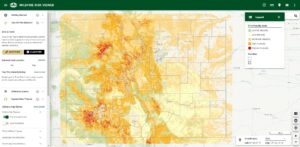
Aerial survey maps and related materials are available on the USFS Region 2 website.

Spruce regeneration, more than 40 years old, near the upper Rio Grande River in an area affected by spruce beetle.Learn More About Common Forest Insects and Diseases

CSFS Insect & Disease Quarterly Reports