Mountain Pine Beetle
The Colorado State Forest Service is monitoring outbreaks of mountain pine beetles on the Front Range and other parts of Colorado. Access resources and guidance for managing this native insect in your trees.
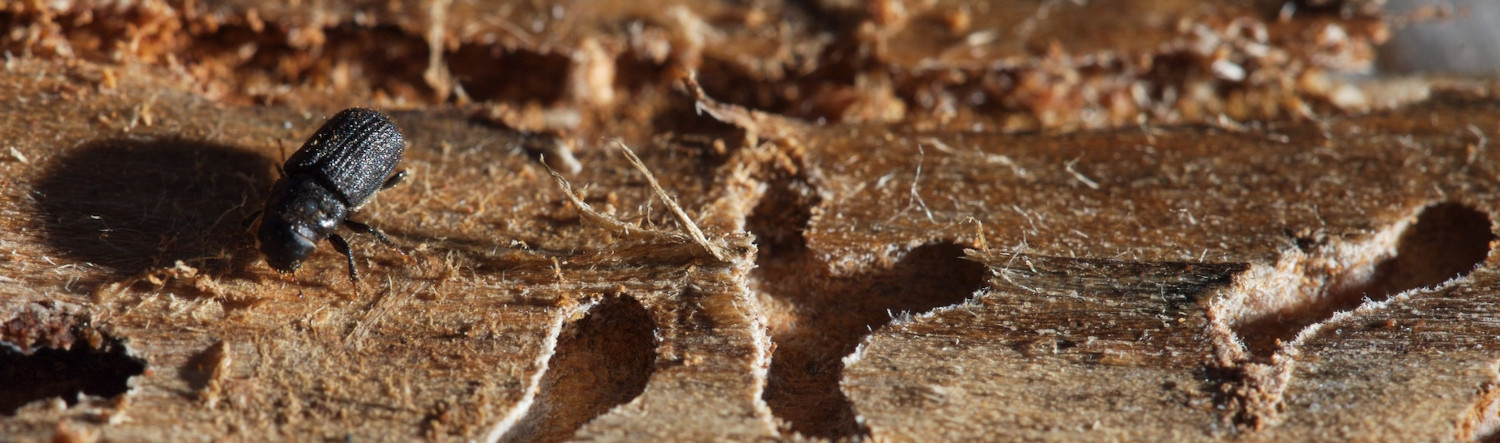
Mountain pine beetles (Dendroctonus ponderosae) are native to the forests of western North America. They are beneficial ecologically when they attack and kill diseased and dying pine trees, clearing the way for healthy, young trees to thrive. When forests are dense, unhealthy and stressed by drought and warm temperatures, however, populations of these deadly insects can explode to epidemic levels and be detrimental to forest health.
From the late 1990s through 2013, mountain pine beetles affected 3.4 million acres of forests in Colorado, predominantly attacking lodgepole pines. They killed up to 80-90% of trees in some lodgepole pine forests in Summit, Grand, Eagle and Routt counties during the epidemic. Along the Front Range in the early 2010s, mountain pine beetles began transitioning into ponderosa pine forests. Heavy rains and flooding ended the epidemic there, leaving many ponderosa pine forests susceptible to future bark beetle infestations.
In recent years, oscillating precipitation and warm temperatures have left pine forests that largely escaped the prior epidemic susceptible to outbreaks of mountain pine beetles.
About mountain pine beetles
Mountain pine beetles complete a generation within one year from egg to adult. Adults typically fly to seek new host trees in July through August, though a small proportion of adults emerge earlier and some later through the summer months. Attacking females initially prefer large-diameter trees until they are depleted from the forest. However, they may attack smaller-diameter trees during an outbreak as populations explode and fewer host trees are available.
Mountain pine beetles predominantly infest ponderosa pine (Pinus ponderosa), lodgepole pine (P. contorta) and limber pine (P. flexilis). However, numerous species of pines – and all pines found in Colorado except for piñon pine – are susceptible to attack when mountain pine beetle populations explode, including ornamental pines.
Signs and symptoms of infestation
Residents should look for these tell-tale signs and symptoms of mountain pine beetle infestation:
- Popcorn-shaped masses of resin, called pitch tubes, on the trunk that may be brown, pink or white
- Boring dust in bark crevices and on the ground immediately adjacent to the tree’s base
- Woodpecker damage, where the birds have stripped portions of the bark in search of larvae, leaving accumulations of bark at the base of the tree
- Presence of live mountain pine beetles (eggs, larvae, pupae and/or adults)
- Exit holes on the bark’s surface where adult beetles have emerged
- Foliage turning yellowish to reddish throughout the entire tree crown, which usually occurs eight to 10 months after a successful attack


Management options
Small infestations can be eliminated through quick action, such as the removal of infested trees. Residents should inspect pine trees in the fall after mountain pine beetle adults fly to new host trees. After the beetles infest a tree, the best practice is to remove the tree by the following spring, ensuring infested wood is disposed of properly to avoid spreading the beetles.
Large outbreaks of mountain pine beetles are difficult to control. One of the best ways to mitigate the effects of beetle outbreaks is to manage for overall forest health and resiliency. Thinning overly dense stands of trees to reduce competition and promote tree age and species diversity is the most successful forest management strategy to increase tree vigor.
Options for Managing Mountain Pine Beetles
- Removal of infested trees and slash from thinning or pruning will prevent beetles from emerging and flying to new trees. Continual removal of trees already affected by other insects or diseases, as well as trees in overly dense areas, should be prioritized, as beetles most frequently attack unhealthy trees. Residents should contact their local transfer station or landfill to dispose of infested wood and slash, or search online for local wood drop-off locations or businesses that may utilize the material. Do not move infested wood unless you intend to drop it off at a secure location as it could spread the beetles.
- Solar treatments can be used to reduce mountain pine beetle populations in small, infested stands. These treatments involve felling infested trees, stacking cut logs off the ground in an area with full sun and covering them with clear plastic. The solar treatment of infested trees creates conditions unsuitable for the survival of the beetle’s larvae.
- Trap trees serve as traps for recently emerged, adult beetles. After the trap trees become infested with beetles, the trees are removed and destroyed, usually during the fall or winter while all of the beetles are still inside.
- The use of pheromone packets containing verbenone, known as semiochemicals, disrupts the attraction of incoming beetles and can be used to reduce attacks on pine trees where no other management options are effective (e.g., in proximity to water or near structures where overspray of preventive insecticides may be undesirable). The effectiveness of verbenone has been much debated in the scientific literature, though recent advances in altered concentrations have proven effective when beetle pressure is low. Consult the CSFS Forest Health Team for more detailed information on using pheromone applications.
- The use of preventive insecticide sprays may prove effective in preventing mountain pine beetle infestation. Specific formulations of pyrethroids that are registered and tested for effectiveness are the primary preventive insecticidal sprays used to help reduce the likelihood of attacks on individual trees. The Colorado State Forest Service recommends spraying only high-value trees, such as those near homes, businesses or recreation sites. Follow the label of any chosen product.
Outbreaks in Colorado
The Colorado State Forest Service monitors the spread of mountain pine beetle outbreaks in Colorado through aerial surveys and on-the-ground reports.
Updated October 2025: Ponderosa pine forests in portions of Larimer, Gilpin, Clear Creek, Boulder, Jefferson, Park and Douglas counties are experiencing elevated levels of infestation from mountain pine beetles. In addition, lodgepole pine forests in Park and Gunnison counties that evaded prior bark beetle outbreaks are experiencing elevated mortality of trees as populations of mountain pine beetles expand.
Explore where aerial observers detected mountain pine beetle activity in Colorado’s forests over the past three years. This map shows data from an annual aerial survey conducted by the Colorado State Forest Service and U.S. Forest Service.
Additional resources
Mountain Pine Beetle (Fact Sheet 5.528) (10.7 MB PDF)
The CSFS offers additional guides and educational materials about mountain pine beetles.