

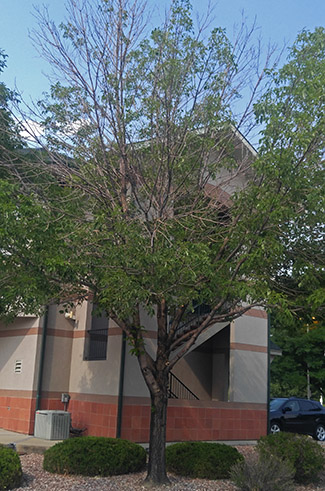
The invasive emerald ash borer spread significantly along the Front Range during the summer of 2025. The non-native, wood-boring beetles attack and kill both stressed and healthy ash trees, which typically die within two to four years after becoming infested. Ash trees comprise about 15% or more of all urban trees in Colorado, so EAB poses a serious threat to urban forests.
“EAB has become so widespread that residents in the Front Range should assume the pest is in their city or town,” said Mary Brand Danser, urban and community forestry program specialist with the Colorado State Forest Service.
This year alone, CSU confirmed the presence of EAB in Aurora, Berthoud, Denver, Edgewater, Golden and Wheat Ridge. The invasive pest was first found in Colorado in 2013 in Boulder.
“Unfortunately, we anticipate the range of EAB will continue to expand southward, likely showing up in Castle Rock or Colorado Springs within the next five years,” said Danser. “But in reality, we’re only one piece of infected firewood away from EAB spreading anywhere in the state. When infested ash wood is moved, it can transport emerald ash borer much faster than its natural spread. That’s likely how the insect made its unexpected jump to Carbondale in 2023 and why it is important to burn wood locally. You never know what pest you might be spreading.”
EAB is responsible for the death or decline of tens of millions of ash trees in the United States and Canada. It was first discovered in Michigan in 2002, and since then it has spread to at least 35 states, including Colorado. As a non-native insect, EAB lacks predators in North America to keep it in check. EAB typically only attacks ash trees in the genus Fraxinus but also has been documented infesting white fringe tree. Mountain ash and other species are not susceptible.
Addressing EAB
The Colorado State Forest Service supports local communities before and after they’ve confirmed the presence of EAB. The CSFS has been tracking EAB since it was first detected in 2013 and providing residents and municipalities with tools for identifying the tree-killing pest.
Communities that suspect the presence of EAB follow this consistent process:
- A city forester or arborist submits initial evidence to the CSFS, including photos of signs and symptoms or samples of the beetle.
- An entomologist at CSU’s College of Agricultural Sciences examines the samples and provides official confirmation if they are indeed EAB.
- The CSFS updates the public detection map.
- CSFS staff can provide technical assistance, community outreach and public announcement support.
EAB treatment can be costly, but it allows communities to retain the environmental and economic benefits — shade, cooling, air quality and neighborhood character — that the existing ash canopy provides while they work to replant a greater variety of trees.
EAB tips for Colorado residents

- Determine now if you have any ash trees. Identifying features of ash trees include compound leaves with five to nine leaflets; leaflets, buds and branches growing directly opposite one another; and diamond-shaped bark ridges on mature trees. Find more information about ash tree identification on the CSFS website.
- If you have an ash tree, start planning. Decide if the overall health of the tree and the benefits it provides merit current or future treatment, or if it would be best to remove and replace it with a different species. If you are not sure, contact your local CSU Extension horticulture agent or an ISA certified arborist. If you do plan to treat the tree, the CSFS offers recommendations for selecting a tree care company.
- Plant trees. Replace ash trees in poor health with diverse species. The Colorado Department of Agriculture offers a database of registered nurseries and landscape contractors.
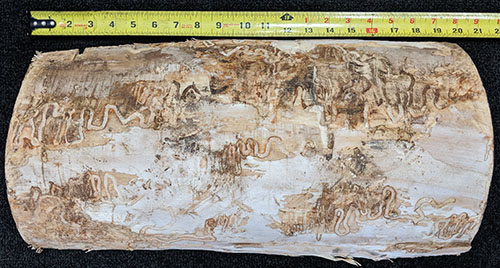
- Recognize signs of EAB infestation. Property owners with ash trees should be on the lookout for thinning leaves in the upper tree canopy, 1/8-inch D-shaped holes on the bark and vertical bark splitting with winding S-shaped tunnels underneath.
- Help prevent further spread of EAB. Residents should contact their city forestry department, CSU Extension office or an ISA-certified arborist if they suspect a tree is infested with EAB. Do not transport ash or any hardwood firewood, or any other untreated ash wood products, to other locations. Dispose of ash wood safely by chipping, composting, milling into lumber or taking to a local landfill.
- Recycle your tree. If it’s too late to save your ash tree, consider working with a local craftsman to transform the tree into a new product. Find local artisans through the Colorado Forest Products Database, Urban Wood Network or Be A Smart Ash programs.
Learn more about ash tree identification, the symptoms of EAB, treatment options and how to use ash wood.