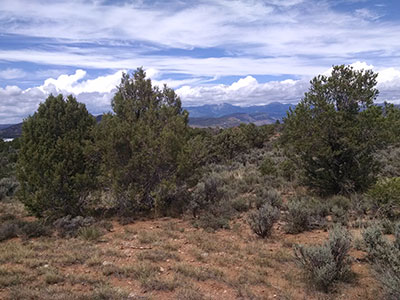
Forest health project protects largest neighborhood in southwest Colorado
The Grassy Mountain Shared Stewardship project improves forest health and resilience in the San Juan Mountains.
The Durango Field Office of the Colorado State Forest Service (CSFS) is one of 18 field offices in Colorado.
Our mission is to achieve stewardship of Colorado’s diverse forest environments for the benefit of present and future generations.
Caleb Marucci – Supervisory Forester
Ryan Cox – Lead Forester
Josh Braun – Forester
Clarissa Dukeminier – Forester
Justin McAfee – Administrative Assistant
Physical Address
914 Talon Lane
Durango, CO 81301
Mailing Address
Durango Field Office
FLC 7233
1000 Rim Dr.
Fort Lewis College Campus
Durango, CO 81301-3908
(970) 247-5250
[email protected]
Directions to our office
Durango Field Office location
USFS/BLM San Juan Public Lands Center (Durango)
San Juan National Forest
Columbine District (Bayfield) / San Juan Mountains Center (Silverton) / Dolores District / Pagosa Ranger District
Canyons of the Ancients National Monument
Tres Rios Field Office
Natural Resources Conservation Service Colorado Area 1
High Desert Conservation District
Dove Creek Conservation District
La Plata Conservation District
Mancos Conservation District
Pine River Conservation District (Ignacio, Bayfield)
We provide technical assistance to local communities through our Community Forestry Program. Our staff help organize local tree boards, conduct tree inventories, assess insect and disease problems, and prepare community forestry management plans.
People often choose community trees for their beauty and ability to provide shade. Trees benefit communities by providing urban forests that many times include social attachment to individual trees. They also improve air quality, control erosion, moderate the sun’s effects and attract wildlife.
Proper tree selection is important when replacing or adding trees to your urban forest. A tree’s shape, characteristics, growth rate and size at maturity should be considered when choosing a location for it.
The following publications provide useful information about tree selection, planting and care:
Durango Tree Guide (5.5 MB PDF)
Tree, Shrub & Perennial Selection and Care Guide (Durango) (5.7 MB PDF)
City Certified Arborists and Tree Care Information (Durango) (3.7 MB PDF)
A Cortez Guide to Selection, Planting, Care – Trees & Shrubs (1.7 MB PDF)

The mission of the Colorado Tree Coalition (CTC) is to lead statewide efforts to preserve, renew and enhance community forests in Colorado. This mission is accomplished through the efforts of dedicated volunteers who work on committees in the following areas: tree grants, the Champion Tree Program, Communitree Awards, Notable Trees of Colorado Calendar, Colorado Tree Trust, National Arbor Day Poster Contest and the development of various publications. For more information, please visit the Colorado Tree Coalition® website.
The State Champion Camperdown elm is located in Mancos. The Durango area also is home to the State Champion mountain alder, Douglas fir, white fir, Gambel oak, southwestern white pine, ponderosa pine and blue spruce. The National Register of Big Trees can be found on the American Forests website.
Each year, the CTC administers grants funded by the USDA Forest Service and the Colorado State Forest Service through the Urban and Community Forestry Assistance Act. The grants are only for tree-related projects and community forestry promotional activities. An educational component should be included in each project. Projects that enhance good community tree planting, care or maintenance, are eligible. In general, projects must be on public property; however, projects on private property that provide public benefit and access also are acceptable.
In 2010, grant dollars will be divided into four tiers (Management/Maintenance, Media, Tree Planting, and Xcel Utility). For more information, visit the Colorado Tree Coalition® website, select Programs and then CTC Grant Program.

The National Arbor Day Foundation (NADF) encourages tree planting and environmental stewardship through educational programs.
Two NADF programs that the Durango Field Office is quite involved with are Tree City USA and Arbor Day celebrations.
Several local communities are certified under the Tree City USA program. Congratulations to Cortez, Durango and Mancos! Fort Lewis College is also a Tree Campus USA-certified community.
Four requirements must be met to receive this honor:
For the last 17 years, Durango also has earned a Tree City Growth Award. This means the city is above and beyond the community’s level of tree care in one of four categories: education and public relations, partnerships, planning and management or tree planting and maintenance.
When a forest is healthy it is resilient to negative changes that occur; forest components include trees, shrubs, grasses, soil and wildlife. Is the forest you live in resilient to heavy rains, bark beetles or wildfire? A healthy forest protects water quality, wildlife and the beautiful view we tend to take for granted.
We provide sound forestry recommendations and assistance to private landowners, communities and cooperating agencies in order to improve forest conditions and amenities such as tree health, wildlife habitat, soil and water conservation, forest products and recreational opportunities.
We accomplish this through a variety of forest management services such as: field visits, forest inventory and mapping, tree planting plans, insect and disease surveys, assistance with forest improvement projects such as timber or other forest product sales and much more. Field visits and other services require a fee.


Please see the CSFS Southwest Forestry Contractor/Service Provider List for a list of consultants in the area that provide forest management services.
Forestry Best Management Practices to Protect Water Quality in Colorado – 2023 (6.2 MB PDF).
The Colorado Tree Farm Program is part of the American Tree Farm System (ATFS), a program of the American Forest Foundation. The ATFS is a privately funded, national tree-growing effort that encourages forest management on private lands.
Their mission is To promote the growing of renewable forest resources on private lands while protecting environmental benefits and increasing public understanding of all benefits of productive forestry. Private landowners can utilize a local, state and national support network to address issues important to private lands.
For more information about Colorado Tree Farmers, please visit their website.
Our seedling tree program encourages landowners to plant new forests and windbreaks that reduce soil erosion, protect homes, cropland, livestock and highways, and enhance wildlife habitat.
The Environmental Quality Incentive Program (EQIP) provides a source of funding and technical assistance through the Natural Resource Conservation Service (NRCS) to support forest management activities. For NRCS office contact information, please visit our Partners section.
The statute allows certain forest lands similar property tax valuation as that of traditional agricultural lands. Forest landowners voluntarily participate in the Forest Ag Program and must fulfill certain requirements annually for eligibility.
Electronic forms are available on the CSFS Forest Ag Program web page.
The Forest Legacy Program is a federally funded and state-administered program that supports efforts to protect private forest lands that are environmentally, economically and socially critical.
The Forest Stewardship Program provides you with information, education and technical assistance. It encourages long-term stewardship of private forest lands and is designed to assist landowners with more actively managing their forest and related resources.
Insects and diseases can pose serious threats to a forest’s health. Our foresters are available for site visits to look at specific insect or disease concerns on your property.
If your questions cannot be resolved with the information provided, please contact the office. For a fee, foresters are available for site visits to look at specific insect or disease concerns on your property. Samples of the problem also can be sent to our state entomologist in Fort Collins for further investigation.
More information may be found on our Spruce Beetle page.
Since 2004, rapid decline in aspen stands has been noticed in southwest Colorado – especially at lower elevations. Additionally, regeneration is sparse in stands with heavy mortality. Researchers have been unable to assign a specific causal agent; however, it appears to be a combination of drought, cankers, borers and defoliators. Ongoing research may provide some answers in the near future.
For more information, view our Common Insects & Diseases of Aspen page.
For more information, visit our Western Spruce Budworm page.
More information may be found on our Douglas-fir page.
For more information, check out our Mountain Pine Beetle page.
More information may be found on our Dwarf Mistletoe page.
For more information, visit our Diseased Trees page.
The annual seedling tree and shrub sales program offers eligible Colorado landowners a convenient source of high quality, affordable planting stock for conservation plantings.
These plantings include:
Native and introduced varieties of trees and shrubs are available.
If you do not qualify, desire larger trees, want landscaping plants or are interested in a species not offered, there are numerous commercial nurseries that should be able to meet your needs.
Seedlings are sold and distributed in our area each spring through these local conservation districts:
High Desert Conservation District (Dolores and Montezuma counties)
(970) 529-8368
La Plata Conservation District (Archuleta, La Plata and San Juan counties)
(970) 247-7956
The application for seedling trees lists the tree and shrub varieties offered and their prices.
Seedlings generally can be ordered from October through the end of March.
Since inventories are limited, order early to insure getting the species and/or type of planting stock desired (bare root, regular potted or small potted).
Call your local conservation district for deadlines and sales tax requirements.
The seedlings are delivered the second or third week in April.
You will be notified of when and where to pick up your trees.
Landowners are encouraged to develop a planting plan before installing a conservation planting. Consider the purpose of the planting, site characteristics, species and type of planting stock, space availability, site preparation, short and long-term maintenance needs, and survival enhancing products/techniques.
Technical assistance is available from the Colorado State Forest Service or your local office of the USDA Natural Resources Conservation Service (NRCS). Both CSFS and NRCS will prepare planting plans and can provide information about potential funding programs for conservation plantings.
Planning & Design Considerations
The Colorado State Forest Service has several tractor-drawn implements available for a fee to landowners for installation of larger conservation plantings.
These can be used to quickly plant seedlings in rows. One is designed for a 3-point hitch and the other attaches to a tow bar.
For detailed information, click here.
This implement lays and anchors weed barrier fabric over rows of planted seedlings. It is designed to fit
on a 3-point tractor hitch. For detailed information, view Mechanized Tree Planting Information (PDF).
Site preparation (i.e. plowing and disking, deep rototilling, etc.) to loosen the soil and eliminate competing vegetation is necessary before using these implements. Ideally, this should be done the autumn before seedlings will be planted. Site preparation also can be done in the spring prior to planting.
The landowner is responsible for supplying the tractor and operator needed to pull these implements. If you do not own or have access to a tractor, you might consider either renting or borrowing one. Please contact CSFS for more information about using these implements. Equipment availability is on a first-come, first-served basis.

The Grassy Mountain Shared Stewardship project improves forest health and resilience in the San Juan Mountains.

CSFS Utilization & Marketing Forester Tim Reader received the award for his work managing the Wildfire Risk Mitigation Loan Fund that has had tremendous economic impact in southwest Colorado.

Many thanks to the volunteers and partners who help the CSFS reach its goals of forest stewardship.