Serving Gunnison and Hinsdale counties

Taylor River watershed in the CSFS Gunnison Field Office area

Providing technical assistance and information to private landowners and homeowners interested in forest stewardship

We do not manage campgrounds, have jurisdiction over public lands or sell recreational licenses.

Meet the staff

Mike Tarantino – Supervisory Forester of Science & Data
Dylan Eimer – Forester
Ashley Baer – Forester
Mitch Dahlke – Forester
Ashley Woolman – Forest Carbon Specialist
Paul Roman – FIA Forester
Marshall Fischer – FIA Forester

Contact us

1141 State Highway 135
Gunnison, CO 81230

(970) 641-6852
FAX (970) 641-0653
[email protected]

Gunnison Field Office location

Forestry services

Forest management
We provide sound forestry recommendations and implementation assistance to private landowners, communities and cooperating agencies in order to improve forest amenities such as tree health, wildlife habitat, soil and water conservation, forest products and recreational opportunities.

The CSFS is also a sponsor of the Forest Stewardship Program, a national effort at forest planning and recognition for forest landowners.

Forest management and timber harvest plans

Good management begins with a sound management plan designed to meet a landowner’s needs. A management plan will identify the landowner’s objectives for their property, describe the resources present and recommend specific practices needed to attain these objectives.

The plan involves an in-depth inventory of the timber as well as the other resources on the property, such as range and/or wildlife. When writing a management plan, we often consult with other natural resource professionals from, for example, the Natural Resources Conservation Service or the Colorado Parks & Wildlife, for their expertise so that the plan is as interdisciplinary as possible.

The CSFS is the primary review agency for county planning departments that require logging plans as part of a land use application.

Timber cruising and mapping

Timber cruising is the process of determining the amount (in cubic feet, board feet or weight) of timber on a given unit (usually acres) of land. Accepted statistical sampling procedures must be used and the accuracy of the “cruise” must be calculated in order to be valid. A qualified professional forester with no financial interest in the sale of your timber should conduct your timber cruise. Sometimes, a landowner may be interested in simply cruising or mapping a particular property or timber stand to determine possible sale potential or value.

We incorporate the latest GPS and GIS capabilities into our mapping of your forested property.

Insect and disease surveys

The CSFS is available to assess your forested lands for insect and disease occurrence and to make recommendations for control where needed. This service is provided as part of any management plan,and is also available to individual lot owners or homeowner associations concerned with specific pests (e.g., Ips engraver beetle, mountain pine beetle or spruce budworm). A diagnostic lab is available through Colorado State University that can further study samples.

Timber sale preparation and administration

A wise seller will know the amount and value of any commodity for sale; this is especially true when selling timber. We offer commercial timber sale layout, marking, cruising (volume determination) and traversing for acreage calculation. We can also prepare timber sale contracts, and have an extensive bidder’s list to assist in offering a sale whether it’s a few cords of firewood or several million board feet of sawlogs.

The CSFS emphasizes on-the-ground implementation of sound forest management principles. Most of the above services require a user fee, which is covered through a standard CSFS service agreement that outlines what we can do for you and associated costs.

Forest agricultural property tax

In 1990, the Colorado legislature enacted House Bill 1229, which allowed certain forested properties to qualify for agricultural property tax status. A landowner, owning at least 40 acres of forested land and willing to manage the property to produce wood products, is now eligible to receive agricultural tax status without necessarily grazing or farming the land (CRS 39-1-102). CSFS is responsible for annually reviewing these properties and making recommendations to county tax assessors regarding “Forest Ag” eligibility.

Landowner assistance programs

For landowner assistance programs, visit our Programs for Homeowner & Landowners page.

Wood utilization

The following CSFS web pages provide information:

Seedling Tree Program

The goal of our tree care program is to provide you with tips to help your trees survive. We offer a single source catalog for seedling survival supplies at reasonable prices because we buy in bulk and pass along the savings. Materials available through our office include drip irrigation kits, polymer soil additive/root dip, tree guards, tree shades, animal repellent and weed barrier fabric.

Throughout the winter, we offer seedling tree care workshops to demonstrate the use of these various products and show you how to plan, plant and care for your trees (1.84 MB PDF) for maximum survival and growth.

Tree Farm Program

The CSFS is a co-sponsor of the American Tree Farm System, a national program that encourages private forest owners to effectively grow trees as a crop by sharing information and through recognition. Certified Tree Farmers receive a Tree Farm certificate, sign, regular mailings of the American Tree Farmer magazine (from the American Forest Foundation) and tree farm newsletters from their own state tree farm committee.

Arbor Day

The first Arbor Day was celebrated in Nebraska on April 10, 1872. It is estimated that more than a million trees were planted across the state of Nebraska on that first Arbor Day. This tree planting holiday was the brain child of J. Sterling Morton, a journalist who moved to Nebraska in the mid 1850s. Arbor Day was a result of the appreciation he had for trees.

Arbor Day is celebrated on many different days throughout the country. The earliest date is in Florida and Louisiana where they celebrate on the third Friday in January. In South Carolina, the first Friday in December is Arbor Day. In Colorado, we celebrate Arbor Day on the third Friday in April; for most of Colorado, this date is ideal for tree planting. However, mountain communities usually wait until May or June. Some communities combine the Arbor Day observance with Earth Day, which is celebrated on April 22. CSFS can provide information and ideas on how to celebrate this tree planters’ holiday. Arbor Day can be any day you choose to plant a tree.

Tree City USA

The National Arbor Day Foundation, in conjunction with the United States Forest Service and the National Association of State Foresters, sponsors the Tree City USA program. This program, in existence since 1976, recognizes communities for their tree care programs.

To become a Tree City USA, a community must annually satisfy the following four standards:

  • A tree board or department – Most communities are not large enough to support a staff position devoted entirely to the care of trees within the town limits. Therefore, a group of citizens is appointed and charged by an ordinance to develop and administer a tree management program for trees on public property. This group of citizens usually serves on a voluntary basis much like other boards in a municipality. Some communities have elected to have the city council or trustees serve as the Tree Board. Larger cities usually have salaried employees to care for public trees.
  • A community tree ordinance – This ordinance gives power to the tree board or department. The ordinance determines public tree care policies for planting, maintenance and removals on public property. A list of recommended trees for the community should be referenced in this ordinance and made available to the citizens of that community.
  • A community forestry program with an annual budget of at least $2 per capita – A town must spend at least $2 per capita on the community forestry program. Examples of acceptable tree-related expenditures include: planting, removals, inventories, maintenance, pest surveys, pruning, public classes on tree care and educational handouts. These expenditures must be applied toward, and directly benefit, the public trees in the community.
  • An Arbor Day observance and proclamation – Arbor Day must be celebrated to fulfill the fourth standard. A proclamation issued by the mayor must accompany the observance, declaring the observance of Arbor Day in the community.

Tree grants

CSFS assists communities wishing to avail themselves of several grants available for public tree planting and education about trees. All tree grants require a level of match by the applicant and, in addition, an action plan. If trees are to be planted a maintenance plan is also required.

The Colorado Tree Coalition (CTC) grant can be for tree planting or educational projects concerning proper tree planting, maintenance or management of the urban forest.

This CTC grant is available to local governments, neighborhood groups and private non-profit organizations. Applicants can request from $500 to $2,000 but must match the requested amount. The match must be with non-federal dollars; in-kind personnel and volunteer services will not be considered as a suitable match. The grant project must have an educational component to it. Grant applications are usually available in the fall with a deadline of mid-December to a local CSFS forester.

Tree care

A community forest is a dynamic entity. As a result, community tree care managers must address the needs and health of these trees annually. The Gunnison Field Office has several programs to assist communities in the effective management of their urban forests.

  1. A tree inventory of the public trees is often the first step toward effectively managing the community forest. A tree inventory can be very useful to the community; it will identify tree species, hazardous trees, pruning needs, insect problems, incidence of disease and open spaces available for tree planting. The inventory is an integral part of any long range plan to sustain the urban forest.
  2. The Gunnison Field Office conducts sick tree calls, by appointment, for private property owners throughout our service area and offers diagnosis and tree care recommendations.
  3. CSFS offers arboriculture courses to tree care personnel in local communities. The knowledge gained through these workshops helps communities maintain healthy forests.

Champion Tree Program

American Forests maintains a national registry of the largest trees in the nation. The CTC administers the Champion Tree Program in Colorado but, since this is a largely volunteer organization, CSFS assists CTC by locating champions, publicizing the program and educating Coloradoans about our “champion” trees.

If you think you might have a champion, take the following measurements:

  • Colorado champion pine – (1) circumference at breast height (i.e. 4-1/2 feet above the ground), (2) overall height and (3) average crown spread
  • The Formula: Circumference (inches) + Height (feet) + 1/4 of the Average Crown Spread = TOTAL POINTS
  • If you think that you have a potential champion, call or write to the CSFS. You can see some of these big trees on the champion tree poster published by the CTC in 1996.

Community forestry links

Wildfire hazard evaluation and mitigation

Many rural Colorado homeowners seek secluded, sheltered homesites. Many do not realize services such as fire protection, often taken for granted in the city, are not readily available at their mountain retreat. The photo above right, shows a typical “secluded” mountain hideaway. The photo on the left illustrates a “defensible space” created by the homeowner. Creating a defensible space around your home involves thinning vegetation adjacent to the structure.

This allows firefighters a safer opportunity to protect your home.

Wildfire hazard area mapping

The Gunnison Field Office can identify and map wildfire hazard areas for county planning departments. ARC/INFO software is used in preparing Geographic Information System (GIS) data.

We assist a county at the desired level whether that is the complete process of photo-typing, ground-truthing, and digitizing the data into the GIS, or just interpreting aerial photography and identifying of wildfire hazard areas.

House Bill 1041 wildfire hazard reviews

The CSFS is the designated state agency by H.B. 1041, to review (upon county request) the Wildfire Hazard “state area of concern.” (CRS 24-65.1-202 – 21 KB PDF). We use state and national (NFPA 299) standards for these evaluations.

Mitigation

Active wildfire hazard mitigation by CSFS includes identifying needed mitigation on-the-ground, funding mitigation programs through cost-share grants and disseminating information through educational materials. Mountain home fire safety information sheets are also available for review.

You may also want to view our Protect Your Home & Property from Wildfire page.

Post-fire rehabilitation

CSFS assists affected landowners with wildfire rehabilitation plans following wildfire events. These plans outline structural erosion control measures and suggest needed re-vegetation to assist the land healing process. Many rehabilitation plans are implemented with cost-share assistance.

For more information, please visit our Post-fire Rehabilitation page.

Wildfire training

The Colorado Wildland Fire & Incident Management Academy has become the place for Colorado, national and international wildfire agencies to receive nationally qualifying National Wildfire Coordinating Group (NWCG) wildfire training.

Wildfire links

Post-fire rehabilitation

The following publications offer guidance about the treatment & management of burned trees:

Gunnison Field Office news

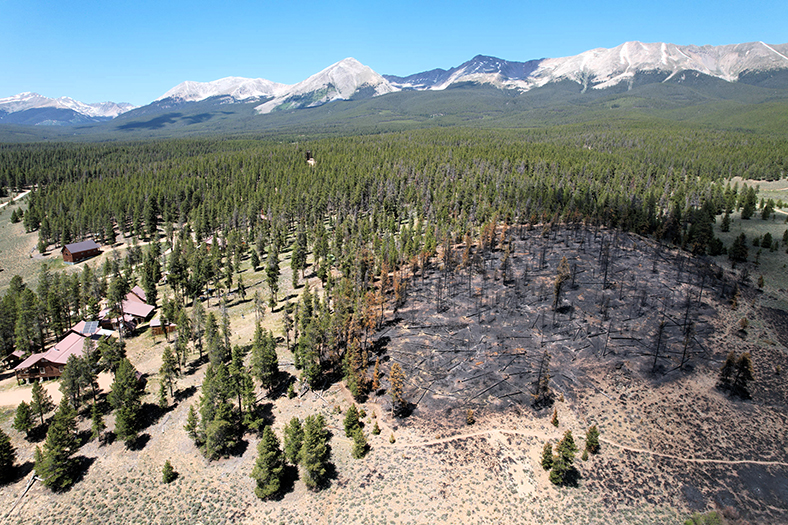
aerial view of a burn scar with snow covered mountains in the background.

Mitigation works: The Illinois Creek wildfire that wasn’t

This success story shows what’s possible when we invest in our forests before wildfires start. Proactive forest management works. And the CSFS and partners play a vital role in protecting communities, ecosystems and water resources from the threat of wildfire.

Type your address or the city or town where you live into the search field on this map.

Map powered by the Colorado Forest Atlas from the Colorado State Forest Service