

EAB: What We’re Doing
Resources for Communities and Homeowners
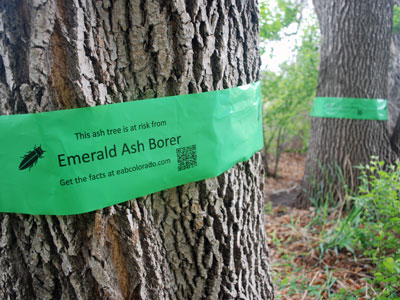
The Colorado State Forest Service works with partners and communities to help them manage urban forests for emerald ash borer (EAB) through a variety of actions:
- Tracking the spread of EAB in Colorado and nationally with USDA APHIS
- Supporting communities with an initial detection of EAB
- Providing management resources for small and mid-sized communities
- Assisting communities with ash tree inventories and wood utilization needs
- Maintaining a statewide tree database to direct management
- Hosting workshops and trainings about EAB for communities and the public
- Providing guides and other educational resources about EAB
Support for initial detections
The CSFS facilitates a process for city foresters and local arborists to confirm an initial detection of EAB in their communities. City foresters and arborists in communities that are not known to have EAB should contact CSFS Urban and Community Forestry if they suspect that an ash tree is infested with EAB. If there is a positive detection, the CSFS offers resources to help communities manage EAB and provide outreach to residents.
Residents should contact their city forestry department, CSU Extension office or an ISA certified arborist if they suspect a tree is infested with EAB.
 Management resources for communities
Your Ash is on the Line was a project funded by the USDA Forest Service and administered by the CSFS to create and share EAB management resources for small and mid-sized communities along the Front Range.
Urban wood utilization study
Ash trees account for approximately 6–18% of public trees along the Front Range, according to the 2025 Colorado Front Range Urban Wood Utilization Study from the CSFS. This means Colorado communities face substantial removals of ash trees and large wood volumes to manage in the years ahead. This wood has value that can help support economic growth and reduce costs to communities to remove and replace ash trees. The study suggests that, based on modeling of scenarios for managing ash trees, removing 25–45% of ash on the Front Range over 10 years would produce 48.2–86.7 million board feet for high value products.
The CSFS will publish the full Colorado Front Range Urban Wood Utilization Study in the fall of 2025 to understand the distribution of ash trees, advance efficient solutions for use of ash wood and support faster, more cost-effective recovery for communities with EAB.