Mountain Pine Beetle

Conditions prime for outbreak of this native insect to expand on Front Range

One of Colorado’s most well-known insects is making headlines once again as it spreads through forests killing trees and turning stands of pines from green to red to gray. Many Coloradans may be familiar with the mountain pine beetle following the epidemic of this native species that affected more than 3 million acres of forests before subsiding in 2013. Now, this same insect is surging in ponderosa pine forests on the Front Range near where many people live, work and play, in forests that mostly escaped the prior epidemic.

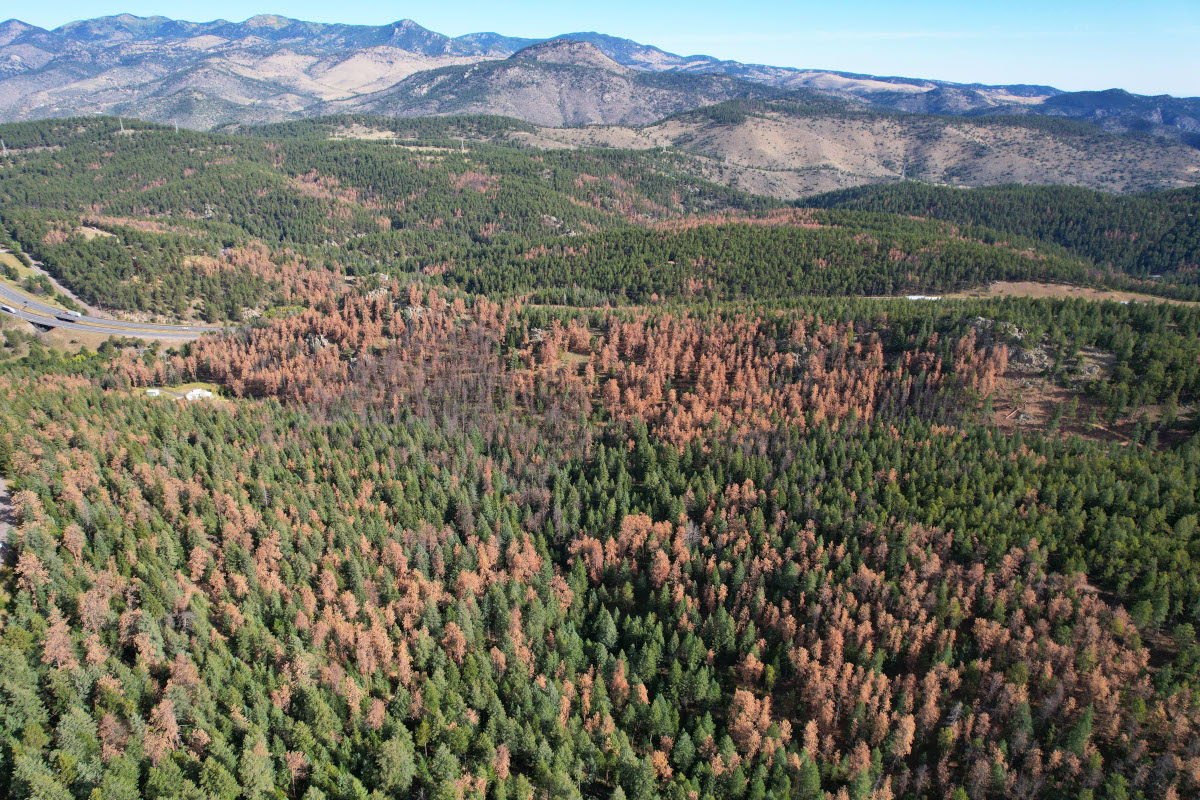
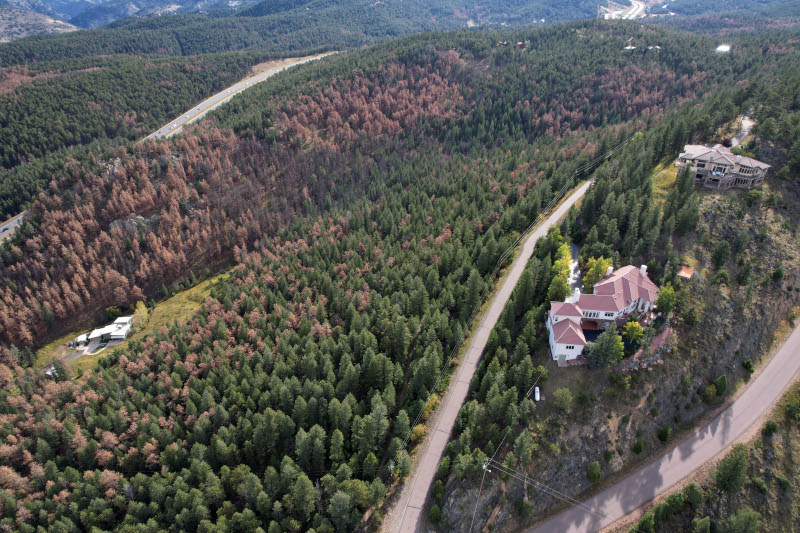
An aerial view of ponderosa pine forests in Jefferson County, Colorado
Pockets of brown, beetle-killed trees show the expansion of mountain pine beetles through forests of ponderosa pine in Jefferson County in September 2025. Gray trees killed several years earlier are also visible. Photo: Dan West, CSFS
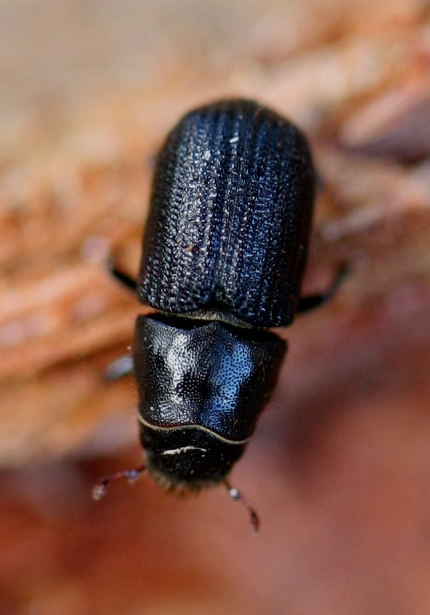
A mountain pine beetle from Colorado
An adult mountain pine beetle is about the size of a grain of rice. Photo: CSFS

Aerial Detection Survey data from the Colorado State Forest Service and USDA Forest Service and on-the-ground reports indicate expanding populations of mountain pine beetles in forests on the Front Range. An analysis of USFS Forest Inventory and Analysis data collected in ponderosa pine-dominant forests in this area of Colorado shows that these forests contain a high percentage of susceptible trees. In addition, this outbreak is occurring in some of the state’s most populated wildland-urban interface areas that have a high risk for wildfire. Swaths of beetle-killed trees in these forests have the potential to affect wildfire behavior and add complexity to an already dynamic fire environment.

Record warm temperatures, periods of drought and irregular swings in precipitation in recent years continue to weaken trees and leave them vulnerable to attack from mountain pine beetles, elevating the potential risk for this outbreak on the Front Range to reach epidemic levels. However, the current outbreak is not yet near epidemic status as of May 2026.

While the outbreak in this area of the state has gained attention lately from Gov. Polis, legislators and the public, infestations of mountain pine beetles are ongoing in other parts of Colorado as well. The CSFS is working with partners to monitor and manage growing populations of this insect in lodgepole pine forests in western Colorado, particularly in Gunnison County. Mountain pine beetles continue to expand their footprints in forests in the Mosquito Range in Chaffee and Park counties, as well as areas of southwest Colorado.

Given growing concern about the outbreak of mountain pine beetles on the Front Range, however, much of the analysis in this article focuses on that region of the state.

A part of nature in Colorado 

Mountain pine beetles (Dendroctonus ponderosae) are native to the pine forests of Colorado and play an important ecological role in culling the forest of unhealthy and dying trees. These beetles are always present in pine forests, usually in low populations that the forest can tolerate, and attacks are limited to weakened or diseased trees. 

Outbreaks occur when populations build because the beetles are more successful at reproducing. This usually happens when susceptible host trees provide sufficient nutrition for the expanding populations and climate conditions reduce or weaken tree defenses, resulting in more available hosts. As beetle populations build, an outbreak can eventually reach epidemic levels, at which point the beetles may completely overwhelm the defenses of even the healthiest individual trees and cause widespread mortality.  

Outbreaks of mountain pine beetles have developed and collapsed across Colorado in recent history, in both lodgepole and ponderosa pines. 

The most recent mountain pine beetle epidemic occurred from the late 1990s through 2013, affecting 3.4 million acres of forests in Colorado. The beetles killed up to 80-90% of trees in some lodgepole pine forests in Summit, Grand, Eagle and Routt counties during that time. They began transitioning into ponderosa pine forests on the Front Range in the early 2010s before heavy rains and flooding ended the epidemic. Many ponderosa pine forests on the Front Range were not impacted by that recent epidemic and are susceptible to future bark beetle infestations. 

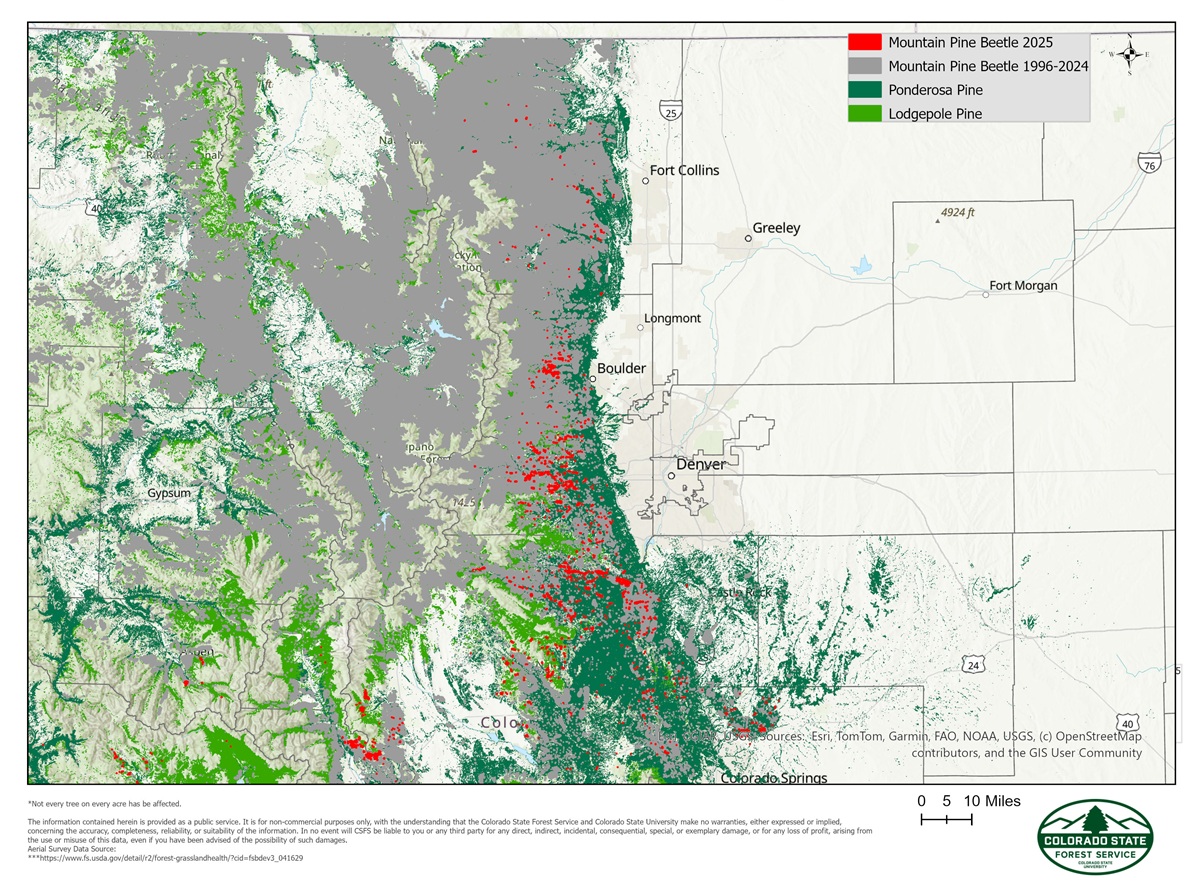
An historical map showing mountain pine beetle progression in Colorado forests
Areas in gray on this map show where mountain pine beetles affected forests in northern Colorado from 1996-2024, according to data from the annual Aerial Detection Survey. Areas in dark green show the ponderosa pine forests on the Front Range that largely escaped the epidemic that ended in 2013 and are now susceptible to attack and widespread mortality. Areas in red show detections of mountain pine beetles in 2025 from the aerial survey. Map: Dan West, CSFS

Well-distributed across the Front Range 

For the last several years, the CSFS has monitored the outbreak of mountain pine beetles on the Front Range, seeing these pockets of infestations expand as beetle populations increase. Given concerns about the spread, staff from the CSFS and USFS prioritized Aerial Detection Survey flights over the nine-county area impacted by the outbreak. 

Results from surveyed areas in Larimer, Boulder, Gilpin, Jefferson, Clear Creek, Teller, Park, Douglas and El Paso counties show increasing mountain pine beetle populations. Impacted acreage in these counties increased from 2,236 acres in 2024 to 5,544 acres in 2025, equivalent to a 148% increase, or 2.48 times the area observed the prior year. On-the-ground reports from CSFS foresters and forest health staff confirmed these aerial observations. 

Pockets of mountain pine beetle activity are well distributed across forests in this area as shown in this map, raising concerns for widespread mortality as these pockets expand. 

Buffet for bark beetles 

Ponderosa pine forests along the Front Range are a veritable buffet for mountain pine beetles. The forests here are home to many medium to very large diameter trees, according to a CSFS analysis.  

The CSFS and USFS work together to collect data about Colorado’s forests through the federal agency’s Forest Health and Forest Inventory and Analysis programs through a longstanding state-federal partnership. Using data from both programs, the CSFS examined conditions of ponderosa pine forests on the Front Range, constructed potential spread scenarios of mountain pine beetles over the next few years and estimated how much wood may be impacted.  

The forests within Larimer, Boulder, Gilpin, Jefferson, Clear Creek, Teller, Park, Douglas and El Paso counties contain roughly 637,751 acres of forests dominated by ponderosa pine, according to estimates based on FIA data. Of these counties, Jefferson, Douglas, Larimer, Boulder and El Paso counties stand out as having the largest projected susceptible acreage and volume of wood. 

Mountain pine beetles typically attack trees with a diameter of 6 inches or more. The CSFS analysis of FIA data indicates that 54% of trees per acre in the nine-county area were in the medium (6-11.9 inches), large (12-17.9 inches) or very large (18+ inches) diameter classes. Those three classes also made up 93% of total basal area of ponderosa pine forests in those nine counties. 

These statistics are based on FIA estimates. Different data sources will provide slightly different estimates. Details concerning the use and limitations of these FIA data, as well as analyses on spread scenarios and the potential volume of wood, are found in the Science & Data Byte, Colorado Front Range Mountain Pine Beetle Outlook: Current Conditions, Future Potential Susceptibility and Capacity to Process Impacted Volume

Wildfire and values at risk

The mountain pine beetle outbreak on the Front Range is not just a concern for forest health – it has the potential to impact public safety, water quality and economies. It’s occurring in some of Colorado’s most populated and high wildfire risk areas, along major travel corridors and in places that matter most for water, infrastructure and recreation. These forests are highly visible to residents and visitors. Hillsides of brown, beetle-killed trees are already noticeable along U.S. Highway 285 and Interstate 70.

A home in the wildland-urban interface surrounded by forest
Mountain pine beetles are killing trees in the wildland-urban interface, an area full of homes and other structures tucked into dense forests with already high wildfire risk. Photo: Dan West, CSFS

Residents, land managers and stakeholders need to better understand the potential scenarios they will face in the coming years as mountain pine beetle populations expand, and how beetle-caused mortality might alter fire behavior and threaten values at risk. The CSFS consulted with academics and scientists, staff and land managers from local, state and federal agencies to synthesize existing peer-reviewed literature, technical papers and on-the ground knowledge and observations in these forested systems to better understand the impacts of beetle-killed trees on wildfire behavior. 

Ponderosa pine forests historically endured a high-frequency, low-severity fire regime that has shifted to a low-frequency, high-severity fire regime because of changes in forest structure and fuel loading. Ample ignition sources, a preponderance of continuous fine dead or dry surface fuels, and alignment with strong winds on the Front Range produce high to very high burn probabilities year-round.

This is amplified by persistent drought and ever-increasing temperatures – climate conditions that are also spurring the outbreak of mountain pine beetles. 

Explore the Wildfire Risk Viewer app within the Colorado Forest Atlas to view data on wildfire risk in areas experiencing infestations of mountain pine beetles.

With the development of homes and other structures within the wildland-urban interface, high to very high annual burn probabilities, and altered forest structure and fuel loading, low-elevation ponderosa pine forests on the Front Range have a higher wildfire risk than many other forests in Colorado, even without the current beetle outbreak. The outbreak and how it impacts the forests will only complicate this challenging fire environment and fire suppression efforts. 

An analysis of the potential effects to wildfire risk, behavior and suppression during and after the outbreak is found in the Science & Data Byte, Mountain Pine Beetle Outbreaks and Changes to Wildfire Risk and Behavior in Ponderosa Pine Forests on the Colorado Front Range

Support for all of Colorado

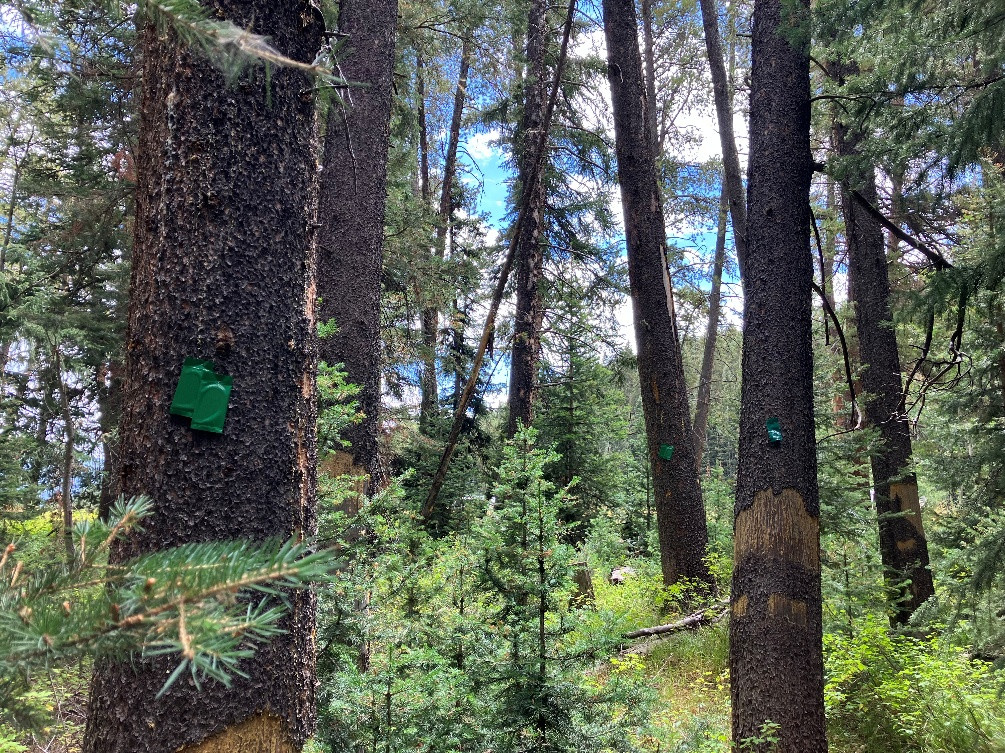
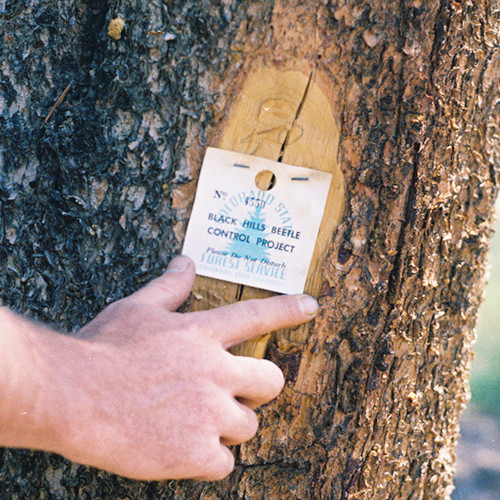
A historical CSFS image showing a tree marked with mountain pine beetle evidence
The CSFS has helped Colorado landowners and managed forests through mountain pine beetle outbreaks since the 1950s. Photo: CSFS

The CSFS has a long history of managing forests during bark beetle outbreaks and will continue to foster this knowledge and expertise to help all Coloradans.

CSFS staff are working with diverse partners at local, state and federal levels to support residents and communities in addressing outbreaks of mountain pine beetles across Colorado. They provide guidance to landowners and administer forest health projects, from the parcel to landscape scales. These projects protect high-value trees; reduce the number of trees in a stand to increase individual tree health, helping trees gain the resources they need to ward off attack; remove beetle-killed trees to reduce fuels or infested trees before adult beetles emerge and fly to new trees; and create forests with trees that are a wider diversity of ages and species.

Diversity in a stand of trees helps keep insect outbreaks at smaller scales. On the Front Range, a lack of sufficient forest management and fire suppression in forests have resulted in many stands with trees that are similar in age, size and species. This lack of diversity means more stands have the highly susceptible host trees that are feeding this outbreak, as noted in the CSFS analysis on this topic.

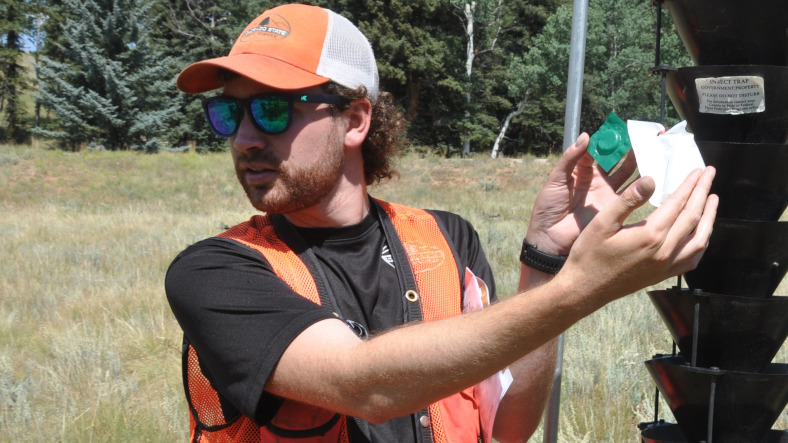
The CSFS also traps adult mountain pine beetles to better understand the timing for flights to new host trees and uses that data to inform management decisions. For example, knowing when adult beetles begin their flights to new trees impacts the timing of when pheromone packets should be placed on trees to deter beetles from attacking them. It also impacts when residents and land managers should prune or remove pine trees, since cut trees may give off a scent that attracts beetles.

The CSFS has been trapping adult mountain pine beetles since 2023. Preliminary results from multiple trapping locations across Colorado indicate flight activity typically begins in early July, peaks during the last week of July and first week of August, and concludes by the first week of September, when most beetles have found new host trees.

More information on bark beetle traps and the use and efficacy of pheromone packets can be found in the Science & Data Byte, Semiochemical Treatments: The Exploitation of Bark Beetle Communication for Forest Management.

The response to the outbreak on the Front Range – and other mountain pine beetle outbreaks across Colorado – will rely on the expertise and coordination of partners and the public. In December 2025, Gov. Polis signed an executive order creating a task force to develop strategies for managing the beetle outbreak on the Front Range. The CSFS co-chairs the task force and also coordinates a coalition of dozens of partners and practitioners who share information and resources for managing mountain pine beetles. In addition, the CSFS will boost its staff to provide additional resources and outreach about this insect in the coming months, helping Coloradans manage their trees and forests.

CSFS resources for managing mountain pine beetles
  • Searchable maps of outbreak locations
  • Guidance on how to identify and dispose of infested trees
  • Management options and strategies
  • Map of sort yards on the Front Range that accept infested wood
  • Contractor lists and tips on hiring a consultant
  • Mountain pine beetle fact sheet

Access these resources

Looking ahead to 2026

Weather plays an important role in the spread of mountain pine beetles. Warmer, drier conditions stress trees and leave them susceptible to attack, so the 2026 outlook looks bad. The previous winter in Colorado was one of the warmest on record, with the hottest February and March in the last 130 years, according to data from the National Oceanic and Atmospheric Administration. Snowpack levels are well below average, so ponderosa pine forests at lower elevations will lack critical early season moisture and likely be stressed by drought. Coupled with the fact that forests on the Front Range are stocked with many trees that are susceptible to attack, the outbreak is likely to continue.

Outbreaks of insects like mountain pine beetles are not cause for panic, however. They are cause for vigilance, preparation and action. Colorado has been here before and we understand the challenges ahead and how best to respond, with strong partnerships, proactive science-based management, community engagement and individual actions.

We cannot prevent outbreaks from occurring – mountain pine beetles are native after all and play an important role in the health of our forests under normal conditions. However, we can work together to save high-value trees, reduce the risks brought by the outbreak, manage fuels and prepare our communities. The actions we take today will shape the landscapes and communities of tomorrow. Together, we can steward the forests we depend on and ensure they continue to serve Colorado for generations to come.

Science & Data Bytes about Mountain Pine Beetles

Type your address or the city or town where you live into the search field on this map.

Map powered by the Colorado Forest Atlas from the Colorado State Forest Service