Semiochemical Treatments: The Exploitation of Bark Beetle Communication for Forest Management
Semiochemicals can be important tools to monitor and control bark beetle populations as part of an integrated pest management strategy.
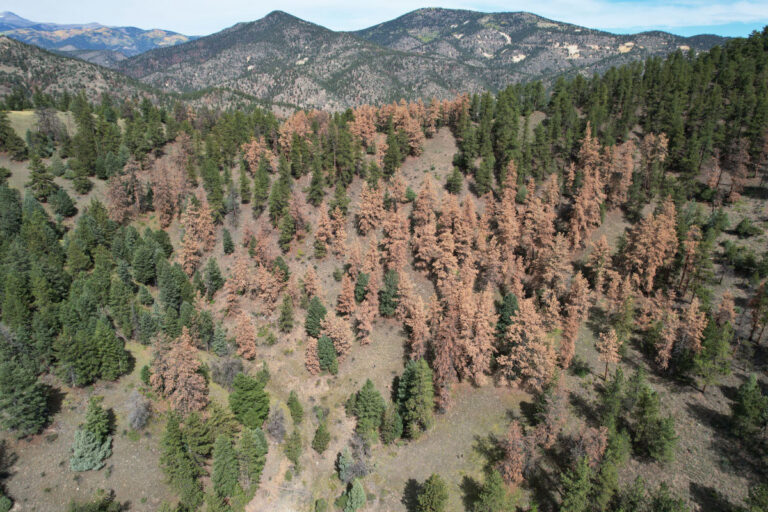
Outbreaks of mountain pine beetles and other insects continued to spread in 2025 during a second consecutive year of hot, dry conditions. Trees in many forests across Colorado remain stressed by above-average temperatures and below-average precipitation and are susceptible to attack by forest pests.
With reduced availability of staff in 2025, the USDA Forest Service and Colorado State Forest Service prioritized flights for the annual Aerial Detection Survey over areas of the state with active bark beetle activity in pine forests, including the Front Range, Mosquito Range and the San Juan National Forest.
The mountain pine beetle is the top forest health concern in Colorado. Aerial survey data show that this native insect is killing trees on 5,544 acres of ponderosa pine forests across nine counties on the Front Range in 2025, compared to 2,236 acres across this same area in 2024. Mountain pine beetles are also expanding their footprints in forests in Gunnison, Chaffee and Park counties.
In addition, aerial survey data show western spruce budworm continues to cause widespread and intense defoliation in Douglas-fir and low-elevation mixed-conifer forests. Western balsam bark beetle, which was the deadliest forest pest in 2024, remains active in high-elevation spruce-fir forests. Douglas-fir beetle continues to kill Douglas-fir trees in most counties in central and southern Colorado. Finally, roundheaded pine beetle and associated native bark beetles are expanding their footprints in ponderosa pine forests in the southwestern reaches of Colorado.
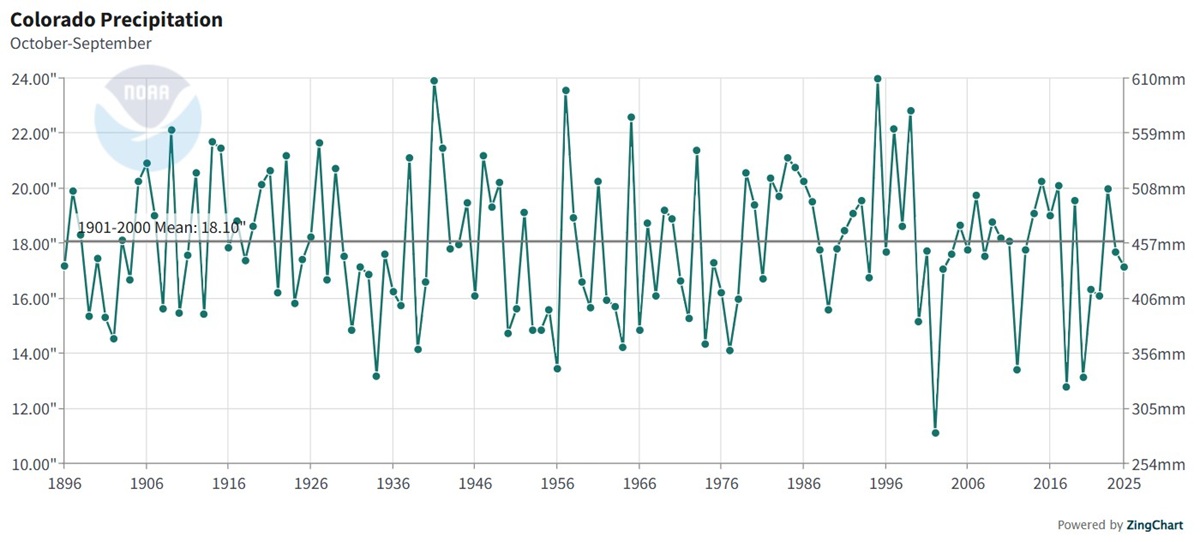
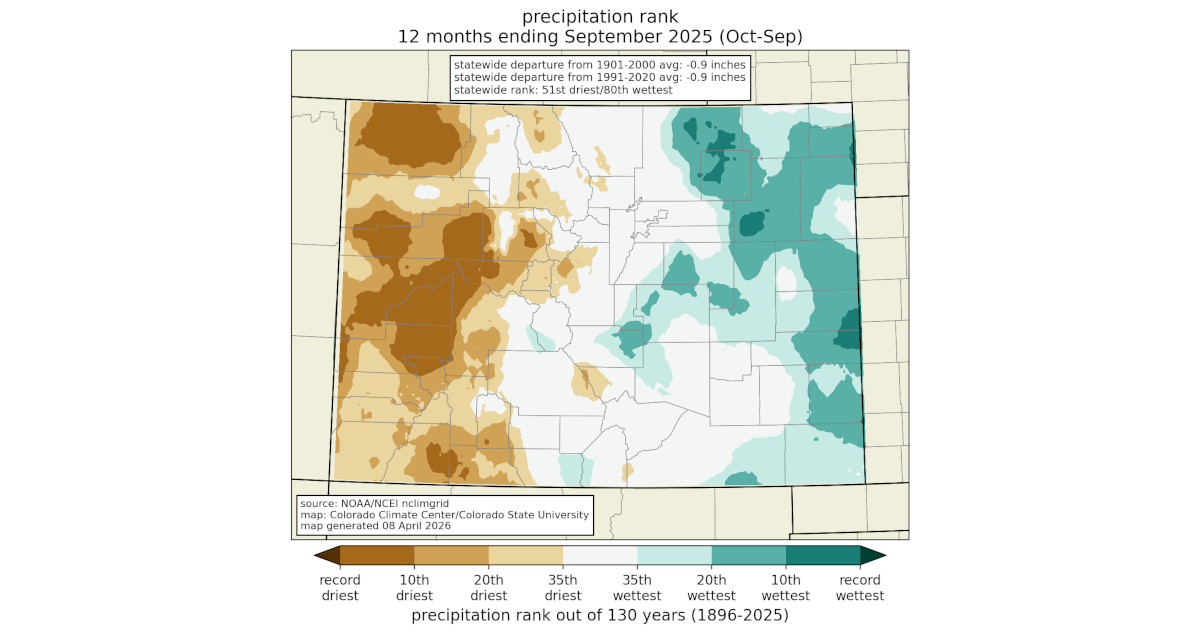
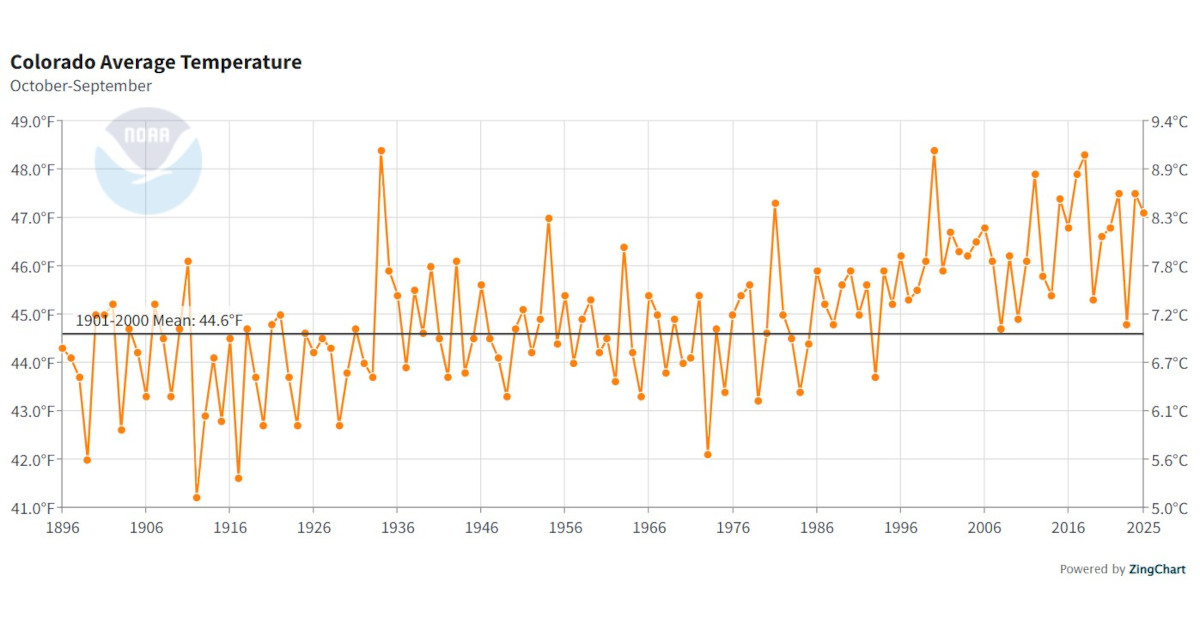
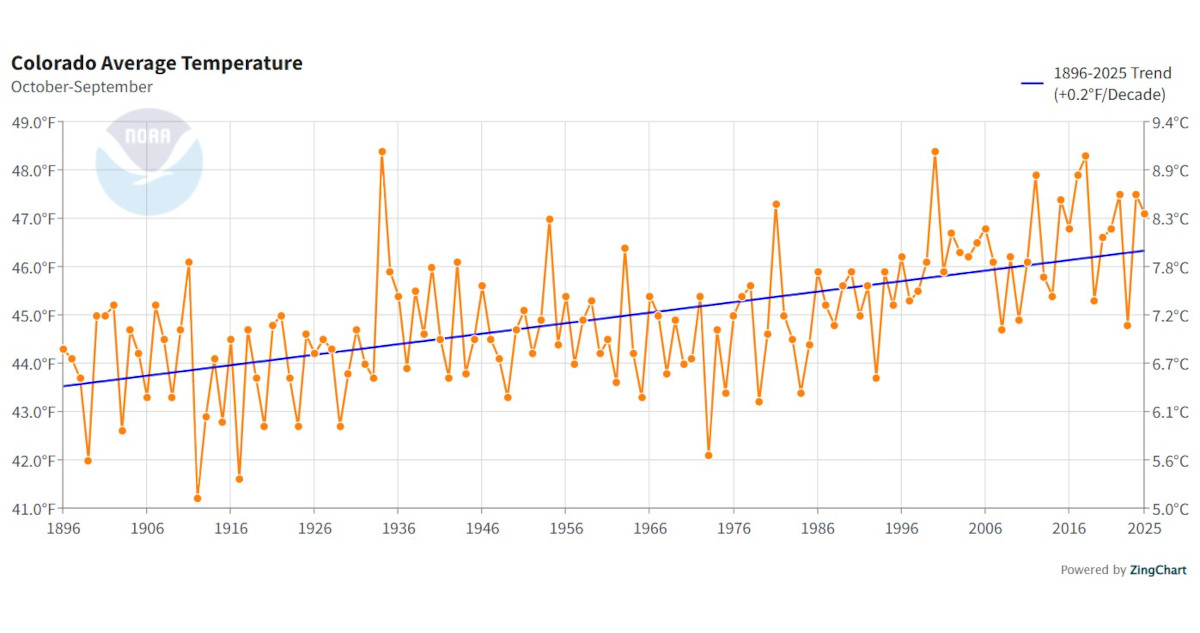
Overall, Colorado experienced above-average temperatures and below-average precipitation during the 2025 water year (Oct. 1 to Sept. 30), further stressing trees.
Warmer temperatures place more demand on trees for water to offset evapotranspiration, which is the process of trees exchanging gases. They release water vapor into the air while expelling oxygen and drawing in carbon dioxide. Trees also need precipitation from rain and snow to produce enough resin to pitch out beetles as they attempt to bore toward the phloem, part of the living tissue within a tree.
Explore data from the National Oceanic and Atmospheric Administration to see trends in precipitation and temperature for Colorado dating back 130 years. Data are presented in water years to align with the natural hydrologic cycle, so the winter snowpack and the resulting spring and summer snowmelt are captured within the same cycle.


Since the 1950s, forest managers have flown over Colorado to detect and monitor disturbances to forests from insects and diseases, collecting data that provide an annual snapshot of forest health. With this information, managers can see how and where bark beetles and other pests are moving across the landscape and proactively manage these forests to lessen their impacts.
In 2025, Aerial Detection Survey coverage of the state by the CSFS and USFS was substantially reduced due to limitations in aircraft and pilot availability and funding. Last year, trained observers surveyed about 13.4 million acres of forests in Colorado, compared to nearly 30 million acres in 2024.
Explore the information below for insights on insect activity from the 2025 Aerial Detection Survey. Because of the reduced acreage surveyed, statewide numbers of acres affected by specific insects are not included in this report since comparison between 2025 and other years is not possible. Locations noted for each insect include data from the aerial survey, as well as reports from foresters and forest health staff working in Colorado’s forests.
Mountain pine beetle (Dendroctonus ponderosae) is spreading in the pine forests of northern and central Colorado, with particular concern about its impact on the Front Range. Ponderosa pine forests on the Front Range largely escaped the prior outbreak of mountain pine beetles that ended in 2013. These forests are highly populated, high wildfire risk areas with many trees susceptible to attack.
Mountain pine beetles infested 5,544 acres of pine forests in a nine-county area of the Front Range (Larimer, Boulder, Gilpin, Jefferson, Clear Creek, Teller, Park, Douglas and El Paso counties) surveyed in 2025, compared to 2,236 acres across this same area in 2024, or a 148% increase. This native insect also continues to impact lodgepole pine in Gunnison County and forests in the Mosquito Range in Chaffee and Park counties, as well as some areas of southwestern Colorado.
Western spruce budworm (Choristoneura occidentalis) is a defoliator that partially consumes the needles of trees during its caterpillar stage. This native insect impacts Douglas-fir stands, mixed-conifer stands with some Douglas-fir trees and some low-elevation spruce trees. Areas significantly impacted by western spruce budworm include Park, Pitkin, Boulder, Grand, Mesa, Delta, northern Larimer and Jackson counties, as well as most Douglas-fir stands in southwestern Colorado.
Western balsam bark beetle (Dryocoetes confusus) and associated root diseases continue to kill trees under chronic, low-intensity conditions where subalpine fir grows, often intertwined with Engelmann spruce. Counties severely impacted by this insect include Jackson, Grand, Larimer, Clear Creek, Park, Lake, Pitkin, Gunnison, Mesa and Delta.
Douglas-fir beetle (Dendroctonus pseudotsugae) continues to impact pure Douglas-fir forests and individual trees growing in mixed-conifer stands. Forests most affected by Douglas-fir beetles remain in parts of Pitkin, Freemont and Teller counties and most counties in central and southern Colorado, including Gunnison, Hinsdale, Mineral and Saguache.
Roundheaded pine beetle (Dendroctonus adjunctus) and associated native bark beetles (mountain pine beetle, southwestern pine beetle, larger Mexican pine beetle and ips engraver beetles) continue to affect ponderosa pine forests in the southwestern areas of Colorado. Counties most impacted are Montrose, San Miguel, Montezuma and Archuleta.
Aerial survey flights in Colorado were limited in 2025. Therefore, this map does not include all forests in Colorado. Shaded areas indicate areas flown last year. Given decreased spatial coverage and detection resolution, data from last year’s aerial survey should be interpreted with caution. The dataset represents a lower-resolution snapshot of forest conditions and likely underrepresents the full extent and distribution of forest health impacts across the state.
As of the publishing of this report in mid-May, the 2026 water year is off to a bleak start in terms of precipitation and temperatures. Colorado experienced its hottest average temperature on record for the first six months of a water year (October through March), according to data from the National Oceanic and Atmospheric Administration. Those six months from October 2025 through March 2026 were the ninth driest on record for Colorado, according to NOAA, and March 2026 was the second driest with 0.45 inches of precipitation, beaten only by 1966 when only 0.39 inches of precipitation fell in Colorado.

What does this all mean for outbreaks of insects and diseases? With above-average temperatures and below-average precipitation, infestations of mountain pine beetle, Douglas-fir beetle, piñon ips, western balsam bark beetle and the complex of native bark beetles associated with roundheaded pine beetle are expected to increase in intensity and expand their footprints in the coming season. Water-stressed trees heading into the summer of 2026 will be vulnerable to attack from forest pests, particularly as insect populations continue to rise from consecutive years of drought in many parts of Colorado.
Western spruce budworm has significantly affected Douglas-fir and Engelmann spruce forests across many portions of Colorado for more than a decade. Defoliation in these forests is expected to intensify in the coming season, which will lead to reduced tree growth, additional stress on trees and heightened susceptibility to subsequent bark beetle activity.

Semiochemicals can be important tools to monitor and control bark beetle populations as part of an integrated pest management strategy.

The CSFS used aerial survey and FIA data to examine ponderosa pine-dominant forests affected by an outbreak of mountain pine beetles in a nine-county area of the Front Range.

The Colorado State Forest Service and its partners conducted a vast majority of their forest management work in high-priority areas of the state and greatly increased the acres of forests they managed and enhanced annually from 2020 through 2024.