Colorado’s Woody Biomass
What is woody biomass?
Woody biomass includes all the organic matter from trees: trunks, branches, roots and even leaves
Colorado’s forests cover about 24 million acres, and they provide numerous benefits to Colorado residents and visitors. Our forests are popular places for campers, hikers, wildlife watchers and hunters, and they also supply clean air and water. It’s critically important to manage our forests to preserve these benefits and to provide economic opportunities through products derived from trees.
To help inform management decisions, the Colorado State Forest Service completed an analysis in 2025 of the statewide woody biomass. This is a comprehensive review of existing woody biomass and the technologies for its utilization, such as lumber, furniture, firewood or bioenergy. In addition to making resources available for decision-making about biomass utilization, this assessment can facilitate efforts to promote carbon sequestration in natural and working lands.
The entire report, Woody Biomass in Colorado: Quantification, Assessment and Opportunities, will comprise eight sections. We encourage you to check back as new sections become available.
Section 1: Introduction
Woody biomass is an abundant and underutilized renewable resource in Colorado in areas where wildfire risk mitigation and forest health stewardship are occurring. This study seeks to offer a comprehensive review of biomass sources and technologies with applicability to the situations and options for forest management — and how the public sector, land managers and private businesses can foster and promote the process.
For study purposes, we divided Colorado into the Eastern Plains, Front Range and Western Forests.
AUTHORS: Steve Rudolph, Kurt Mackes, Tim Reader, Amanda West Fordham, Maria Gaetani, with support from the Beck Group
Section 2: Forest Conditions in Colorado
Colorado’s forests are diverse ecosystems that face mounting challenges from drought, insect outbreaks and uncharacteristic wildfires. Wildfire suppression and reduced timber utilization have left many forests overstocked and vulnerable, with wildfires since 2018 — including the record 2020 season — causing severe ecological, social and economic damage.
The CSFS plays a central role in monitoring forest health, supporting wildfire mitigation and guiding long-term management through its Forest Action Plan, which emphasizes supporting and growing the state’s wood products industry. Biomass removal and utilization are highlighted as critical strategies to reduce fuel loads, protect watersheds and communities, store carbon, create renewable energy, support rural economies, and sustain recreation and clean air. The stewardship of Colorado’s forests is both a practical necessity and an ethical responsibility to safeguard life, property and natural resources for future generations.
AUTHORS: Steve Rudolph, Kurt Mackes, Tim Reader, Amanda West Fordham, Ashley M. Prentice, Trent Raddatz with support from the Beck Group
Section 3: Characterizing and Quantifying Forest Resources in Colorado
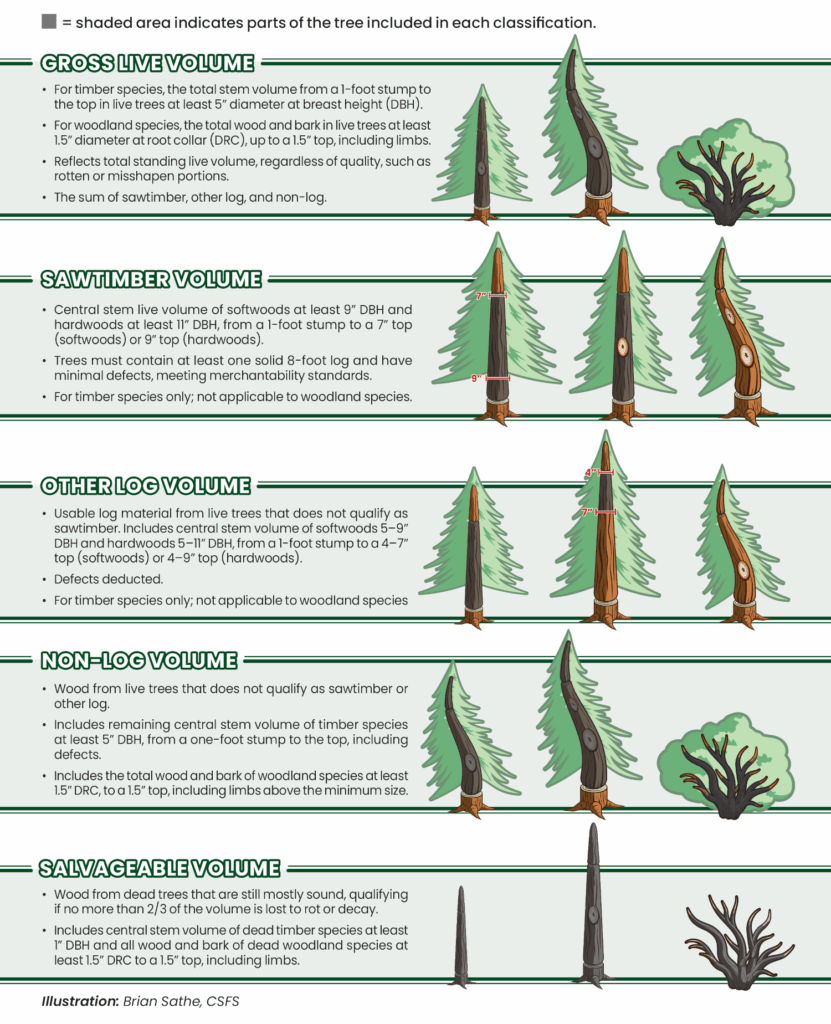
Quantifying biomass resources is a critical step to manage forests at the landscape scale. We analyzed data to understand the available woody biomass across Colorado, including federal, state, tribal, local government and private lands. This section details the analysis and provides graphical and tabular data for interested stakeholders to explore.
AUTHORS: Ashley M. Prentice, Amanda West Fordham, Ethan Bucholz, Maria Gaetani, Steve Rudolph
Section 1: Introduction
Woody biomass is an abundant and underutilized renewable resource in Colorado in areas where wildfire risk mitigation and forest health stewardship are occurring. This study seeks to offer a comprehensive review of biomass sources and technologies with applicability to the situations and options for forest management — and how the public sector, land managers and private businesses can foster and promote the process.
For study purposes, we divided Colorado into the Eastern Plains, Front Range and Western Forests.
Section 2: Forest Conditions in Colorado
Colorado’s forests are diverse ecosystems that face mounting challenges from drought, insect outbreaks and uncharacteristic wildfires. Wildfire suppression and reduced timber utilization have left many forests overstocked and vulnerable, with wildfires since 2018 — including the record 2020 season — causing severe ecological, social and economic damage.
The CSFS plays a central role in monitoring forest health, supporting wildfire mitigation and guiding long-term management through its Forest Action Plan, which emphasizes supporting and growing the state’s wood products industry. Biomass removal and utilization are highlighted as critical strategies to reduce fuel loads, protect watersheds and communities, store carbon, create renewable energy, support rural economies, and sustain recreation and clean air. The stewardship of Colorado’s forests is both a practical necessity and an ethical responsibility to safeguard life, property and natural resources for future generations.
Section 3: Characterizing and Quantifying Forest Resources in Colorado
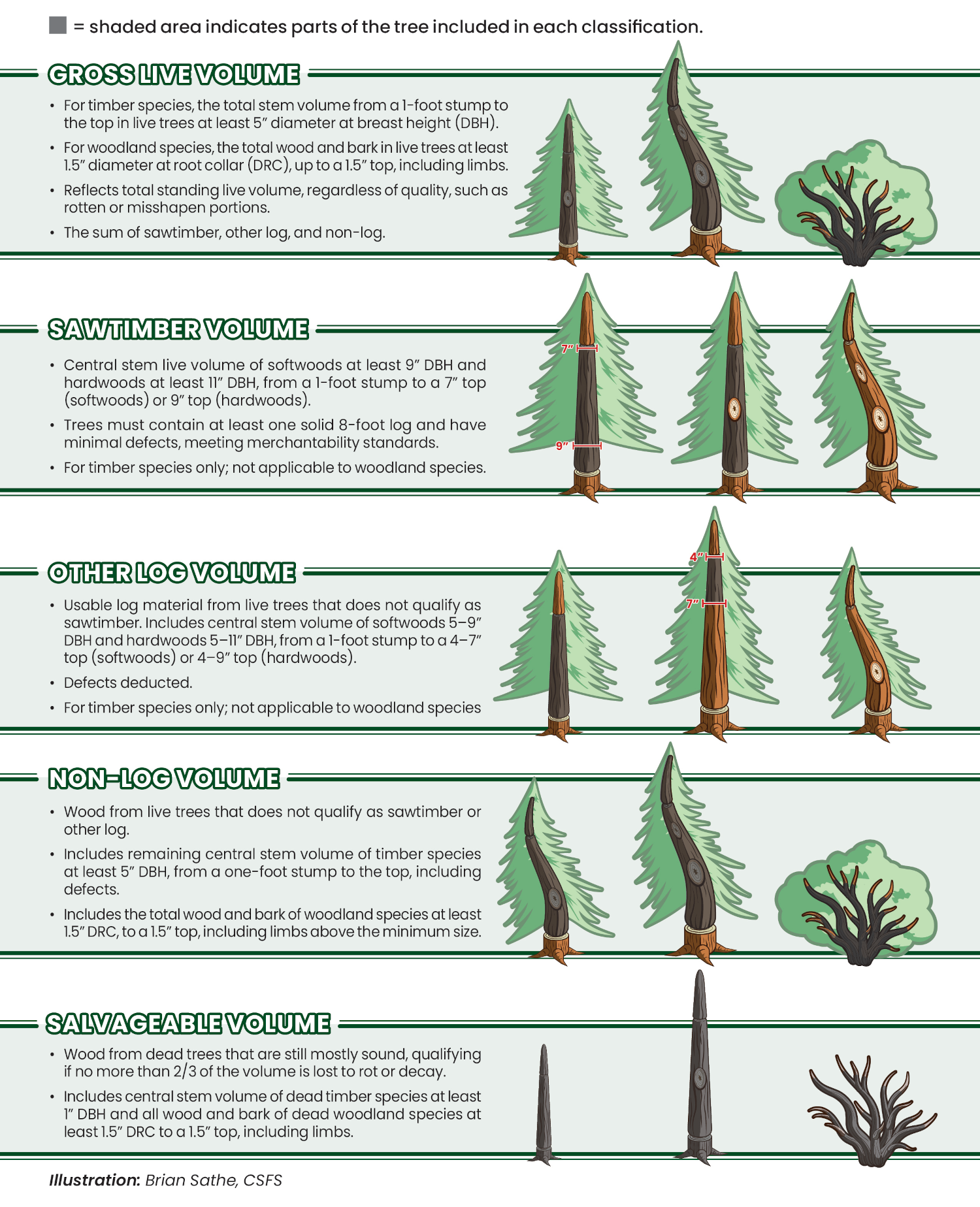
Quantifying biomass resources is a critical step to manage forests at the landscape scale. We analyzed data to understand the available woody biomass across Colorado, including federal, state, tribal, local government and private lands. and provides graphical and tabular data for interested stakeholders to explore.
Section 4: Biomass Harvesting, Transportation and Delivery Systems
Colorado is a net consumer of forest products, with dozens of applications spanning a variety of uses. Prominent among these are lumber for home construction, fencing and decking, cabinetry, furniture and small artisanship, remodeling, pallets, landscaping, infrastructure (including highway construction and railroad work), utility poles, fencing, pulp and paper, animal bedding and care, heating, and specialty products like biochar. While not all of these applications are feasible for manufacture within the state, there are ample possibilities for many if barriers can be overcome.
Section 5: Wood Products and Woody Biomass Utilization, Consumption and Production in Colorado
Colorado is a net consumer of forest products, with dozens of applications spanning the gamuta variety of uses. Prominent among these are lumber for home construction, fencing and decking, cabinetry, furniture and small artisanship, remodeling, pallets, landscaping, infrastructure (including highway construction and railroad work), utility poles, fencing, pulp and paper, animal bedding and care, heating, and specialty products like biochar. While not all of these applications are feasible for manufacture within the state, there are ample possibilities for many if barriers can be overcome.
Section 6:
Biomass utilization technologies can be grouped into energy-related, traditional/engineered wood products, and other miscellaneous products. Energy-related uses are common in Colorado and could be expanded. Depending upon the supply types available, traditional or engineered wood products could be welcome additions to local and/or regional markets. Each situation is unique, and requires consideration of available supply, local markets and attitudes in order to advocate for the best use of regional biomass resources.
Section 7: Social, Economic and Environmental Considerations Associated with Woody Biomass Utilization
While our state has plentiful timber resources, they are neither harvested nor processed in a vacuum. The population (including its state government) cares about the environment, and is not afraid to speak its mind. Any biomass process should consider public relations and opinion and engage in outreach to hear and address concerns. Biomass utilization produces jobs and positive economic impacts therefrom, especially impactful in rural areas with limited economies or those heavily dependent on fragile sources such as tourism. Utilization strategies must satisfy public and scientific environmental concerns, but when properly planned and presented can be helpful beyond the simple equation of less fires = less danger and waste.
Section 8: Introduction to Sustainable Wood Utilization Opportunities
With suitable funding commitments, Colorado has the potential to combine our own knowledge of the state’s forests with innovative solutions to reduce wildfire risk and promote forest and watershed health, sustaining the resources that make Colorado as the water tower of the Western US, provide diverse forest habitat and create a great place to live, work and visit. Transportation distances and workforce presence and knowledge are factors that can be difficult, but not insurmountable. If we combine creativity, received wisdom, scientific understanding and openness to solutions specific to given situations—even if they might seem unorthodox—funding can be deployed where it will do the most good.