Feature Stories

2013 Features

Motorcycle Club Plants 1,900 Seedling Trees in High Park Burn Area

On May 11, the Sleigh Riders, a Greeley-based motorcycle club best known for delivery of donated toys at Christmas, planted 1,900 seedling trees in the High Park Fire burn area.

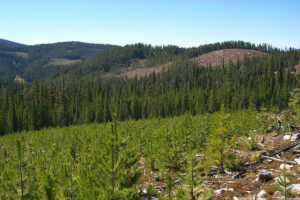
Sleigh Riders motorcycle club members and other volunteers in the Stove Prairie vicinity of the 2012 High Park Fire.

The trees were planted in the Stove Prairie vicinity as part of a coordinated volunteer effort led by the Colorado State Forest Service.

The seedling trees, a mixture of ponderosa pine and Douglas-fir grown at the CSFS Nursery in Fort Collins, were planted on private properties impacted by the fire. The planting will help accelerate regeneration and ultimately protect water supplies, restore wildlife habitat and reduce flooding and erosion.

“We ride these roads a lot for relief and soul searching,” said Charley Barnes, founder and president of the nonprofit Sleigh Riders. “We wanted to give back, and also be able to ride this road in 20 years and see what we planted.”

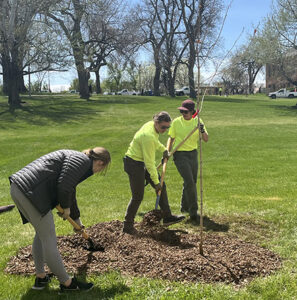
The Sleigh Riders volunteered to plant seedling trees in the High Park Fire burn area (member, Mike Neuerburg, shown in photo).

The Sleigh Riders' primary function is an annual Christmastime Motorcycle Toy Run that began in 2006. Each December, the police-escorted parade winds through Greeley as more than 350 motorcycles deliver donated toys to families in need.

Mike Hughes, assistant district forester for the CSFS Fort Collins District, led the weekend planting efforts; additional volunteers from the Environmental Ministry Team at Plymouth Congregational Church in Fort Collins also contributed to the effort. Hughes said the affected landowners were extremely appreciative of everyone's efforts.

“The Sleigh Riders and other volunteers worked hard and really planted a lot of seedlings,” Hughes said. “There's nice moisture in the ground now, so these trees have a great chance at survival.”

Other landowners in the High Park burn area recently received more than 4,000 seedlings from the CSFS-administered Restoring Colorado's Forests Fund, which provides trees through donations from Colorado businesses and private citizens.

To help provide seedlings for planting on lands impacted by the High Park Fire and other natural disasters, citizens can donate to the Restoring Colorado's Forests Fund.

Safety Tips for Replanting in Burn Areas

Many private landowners, volunteer organizations and other groups are now planting seedling trees to reforest areas burned by Colorado wildfires.

Falling trees represent the primary risk to individuals working in burn areas.

Before heading out to the field to plant, the Colorado State Forest Service recommends that everyone involved familiarize themselves with the following safety considerations.

Falling Trees

Falling trees represent the primary risk to individuals working in burn areas. Trees that have been even partially burned may have weakened trunks and/or roots, and can fall at any time, putting anyone on site at risk.

Even unburned trees may fall unexpectedly due to increased exposure to wind after a fire.

The CSFS recommends removing all hazard trees at a planting site prior to planting. This is especially important when badly burned, dead trees are in the vicinity. It is advisable to hire a qualified tree faller to cut down these hazard trees.

Partially burned or dead trees often contain rot in the stump sections, making tree felling especially hazardous. Besides reducing the risk to life safety, another benefit of removing hazard trees prior to planting is that it reduces the risk of damage to new plantings when the trees fall or are removed. Felled trees also can be used as contour logs to control erosion in a planting area.

When electing to plant in an area that still contains hazard trees, the following guidelines can help reduce safety risks:

  • Never enter burn areas on windy days! Even if you have a large group ready to plant, it is best to cancel to ensure everyone's safety if high winds are predicted.
  • Always include a "spotter" during planting operations. The sole job of the spotter is to watch the standing trees above those doing the planting. The spotter can shout to others if they see trees swaying, or if winds are increasing and could escalate the overall falling risk. If the wind increases, everyone should move to a designated safety zone.
  • Assume that every tree in a burn area is a hazard tree. However, trees with obvious defects should be especially avoided. Don't work in the vicinity (closer than 1.5 times the height of the tree) of dead and blackened trees or any trees with:
    • Less than 50 percent live foliage
    • Trunk injuries or large broken branches
    • Lightning scars below the top fork
    • Root rot or significant root damage
  • Consider flagging around obvious hazard trees in advance to make them more identifiable to anyone working in a burn area. This might be done by creating a ring of flagging tape at a safe distance around each identified hazard tree.
  • Avoid any physical contact with hazard trees.
  • Maintain personal awareness. If the wind increases, stop planting and look up at the trees around you. If the trees are swaying or you are concerned about the falling risk, leave the area immediately for a pre-designated safety zone.

Tripping/Rolling Hazards

Steep, barren slopes in burned landscapes can be difficult to navigate. Always move with caution in burn areas, and be sure to not dislodge rocks or logs that could roll down-slope into someone working below you. Conversely, do not work directly underneath anyone else on steep, unstable slopes.

If you ever dislodge a rock on a slope, immediately shout "ROCK!" to alert others to the danger. Also, beware of hidden underground hazards where stumps have burned out in the fire, which leave hollow areas underfoot that are tripping hazards.

Storms/Lightning

Badly burned hillsides may not effectively absorb rainwater. During a rainstorm, these slopes may become dangerous due to mudslides, rolling and sliding logs, rocks and other debris, and high volumes of running water. Avoid planting if significant rain is in the forecast and cease operations if heavy rains develop while working.

Approaching thunderstorms also can bring erratic, powerful winds and lightning. Be especially alert to the risk of falling trees in strong winds before a storm, and observe the 30/30 rule: if you hear the thunderclap within 30 seconds of a lightning strike, stop working outside until 30 minutes after the storm has passed. Vehicles or fully enclosed buildings provide the safest shelters.

Other Risks

Do not approach within 5 feet of electrical wire, fences, man-made structures or other physical property on the site. Risks in these areas include broken glass, nails, live electrical wires, severed barbed wire and jagged edges where structures have burned.

Personal Protective Equipment

The CSFS recommends that, at a minimum, the following equipment be worn by anyone entering a burn area:

  • Hardhat
  • Leather gloves
  • Sturdy hiking boots
  • Eye protection
  • Long-sleeve shirt and long pants

Personal Responsibility

Whether working by yourself or with a large group, always assume responsibility for your own safety. If anything about a planting site seems threatening, use your best judgment to avoid a potential accident. Do not wait for a leader to make safety calls for you.

For More Information

If you have questions or concerns about post-fire replanting, please contact your local CSFS District Office.

Interim State Forester Joe Duda Presented Safety Award from USDA Forest Service

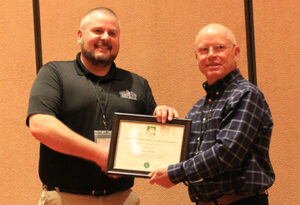
Joe Duda, interim state forester with the Colorado State Forest Service, recently was presented the 2013 Forest Health Protection Aviation Safety Award from the USDA Forest Service for “outstanding contributions to aviation safety and support to forest health programs.”

Joe Duda, interim state forester with the Colorado State Forest Service.

Only one candidate from state and federal organizations involved in national USFS aerial survey programs receives the award each year.

The award is given for promoting a positive aviation safety culture, conducting forest health activities that directly benefit the resource, and for building efficiencies among federal and state partners.

On May 2, James Hubbard, deputy chief of the USFS State and Private Forestry Program, presented the award to Duda in Fort Collins.

“Joe continually places safety as the highest priority and has substantially contributed to developing a positive, effective and long-term cooperative forest health relationship,” said Hubbard.

For the past several years, Duda has participated in at least one aerial detection survey flight annually and in numerous meetings and trainings. He says that being a program lead with personal involvement in the flights provides him an opportunity to be aware of the unique challenges aerial observers face, and ensure that everyone involved is promoting a safe and effective work environment.

The USFS Forest Health Protection Program established the award to commemorate the aerial survey crew of aircraft N30266 – Rodney Whiteman, Dan Snider and Patrick Jessup – lost on a 2010 aerial detection flight in Pennsylvania.

Each year, observers with the CSFS and USFS together conduct an aerial survey to map insect and disease activity in forested areas of Colorado. The survey, which involves flying from July through September, provides a snapshot of landscape-level forest conditions that may be monitored and addressed more closely by on-the-ground assessments.

“It's easy to work with our partners in the USFS Forest Health Protection Program, who are passionate and dedicated,” Duda said. “The real heroes are the folks frequently going up in the aircraft and conducting the aerially surveys. Their safety is our top priority.”

Colorado State Forest Service Offers First Aid Tips for Snow-Damaged Trees

Many northern Front Range residents may be dealing with damaged trees from the early May snowstorm that dumped moisture on Colorado.

Tree covered with heavy snow. Photo: CSU

Community Forestry Program Manager Keith Wood of the Colorado State Forest Service said that although the first impulse may be to start sawing when a tree is damaged, homeowners should assess the situation first to avoid hurting themselves or further damaging the tree.

Wood and the CSFS offer the following tips for dealing with snow-damaged trees; the tips were adapted from International Society of Arboriculture (ISA) recommendations:

  • Check for hazards. Before approaching a tree, examine your surroundings to avoid making contact with downed utility lines or standing under hanging branches that are broken and ready to fall.
  • Contact city officials if necessary. Trees between the street and a city sidewalk may be the responsibility of city crews.
  • Assess the damage. If a tree is healthy overall and still possesses its leader (the main upward branch), most of its major limbs and 50 percent or more of its crown, the chance is good for a complete recovery.
  • Be careful knocking snow off branches. This may cause the branches to break. If you must remove snow, gently push up on branches from below to prevent adding additional stress.
  • Remove broken branches. This minimizes the risk of decay and insects or diseases entering the wound. Prune at the branch collar – the point where a branch joins a larger one – and be mindful of potential pent-up energy if the branch is twisted or bent.
  • Don't over-prune. With the loss of some branches, a tree may look unbalanced, but most trees quickly grow new foliage that hides bare areas.
  • Don't try to do it all yourself. If the job requires running a chainsaw overhead, sawing from a ladder or removing large branches or entire trees, contact an insured, certified arborist. Professionals often are listed in the phone book under "tree services."

For more information about tree care and protection, visit our section on Trees.

To find an ISA-certified arborist, visit www.isa-arbor.com.

Project Learning Tree Grant has Lasting Impact on New Colorado STEM Coordinator

The Colorado Department of Education recently hired its first-ever STEM coordinator to help students excel in math and science, and prepare them for 21st century professions.

Dr. Violeta Garcia, past recipient of a Project Learning Tree GreenWorks! Grant, was recently appointed as Colorado's new Science, Technology, Engineering and Mathematics (STEM) Coordinator.

STEM educators incorporate inquiry, critical thinking, invention and collaboration in their curricula to help students succeed in technical disciplines and careers.

New STEM Coordinator Works on Curriculum Project

Dr. Violeta Garcia, the new Colorado STEM coordinator, is in the process of launching Colorado's District Sample Curriculum Project. The project provides teacher-created curriculum samples based on Colorado Academic Standards that integrate STEM concepts.

Development of the curriculum project involved more than 500 Colorado educators who participated in the creation of 670 curriculum samples for all 10 content areas of the K–12 Colorado Academic Standards.

Project Learning Tree GreenWorks! Grant Recipient

Prior to becoming Colorado's STEM coordinator, Garcia was a recipient of a Project Learning Tree (PLT) GreenWorks! Grant. PLT is the flagship program of the Colorado State Forest Service for reaching younger audiences via professional development workshops for Pre-K–12 educators.

PLT-trained educators can receive GreenWorks! Grants that facilitate partnerships between their students and local communities. Garcia received a GreenWorks! Grant in 2007 for her project at Lincoln Junior High School in Fort Collins, Colo.

The goal of the project was to have her eighth-grade students partner with the local community to build a terrarium where students could see multiple Colorado ecosystems in one place. The students transformed their neglected school atrium into the terrarium, creating an improved learning environment for both the students and the local community.

Programs such as PLT and STEM provide hands-on, learning-by-doing experiences that help students develop their own identities as scientists and environmental stewards.

“I'm always pleased when Colorado educators apply for and receive GreenWorks! Grants, as it indicates that they are using PLT activities and resources to help students achieve academic success while learning to become stewards of our natural resources,” said Shawna Crocker, Colorado PLT Coordinator, Colorado State Forest Service.

“That Dr. Garcia used PLT activities with her students serves as an example to other educators that PLT activities are useful in helping students gain success while achieving state STEM goals.”

Conference Focuses on STEM Education

Last November, Garcia presented at the “Take Flight with the Colorado Collaborative: Building Opportunities for Girls in STEM” conference in Denver. This conference provided the opportunity for Crocker to reconnect with Garcia and explore possibilities for expanding PLT and CSFS outreach into state STEM networks.

The focus of the conference was involving women and minorities in STEM-related careers. Garcia talked about her experience as a first-generation college student from El Salvador and how those experiences influenced her role as a science educator. Throughout her presentation, Garcia emphasized the importance of providing experiences for girls and minorities in hands-on, learning-by-doing STEM education.

El Espejo Program for Girls

Garcia says her “Aha!” moment about motivating students occurred while leading a program, called El Espejo, at the Poudre Learning Center. El Espejo, which is Spanish for "the mirror," allows girls to experience science first-hand.

“El Espejo allowed girls to participate in their own science experiments where they could see that science is fun and build their identities as scientists early on,” said Garcia. “The best way to motivate students to participate in science careers is to give students those early, hands-on experiences.”

Garcia reiterated this theme throughout her presentation at the 2012 STEM conference in Denver, emphasizing that when girls and minorities learn from role models who have succeeded in STEM careers, they are more likely to develop their own scientific identities and become STEM professionals themselves.

Hoping to spark interest in STEM careers, she currently is working on a STEM in Action Program that provides experiential learning opportunities to rural and underrepresented students.

Private Landowner Participation Helps Foresters Monitor Statewide Forest Health

In April, private forest landowners around the state will be receiving letters from the Colorado State Forest Service to request property access to collect essential data about forest health conditions in Colorado.

Forest Inventory and Analysis (FIA) technician collects data on forested land conditions. Photo: USFS

The requests are part of the National Forest Inventory and Analysis (FIA) Program – the principal source of information used to assess the status of America's forests.

CSFS Leads FIA Process in Colorado

Colorado is the first state in the Rocky Mountain Region where leadership of the FIA process has been assumed by a state agency. Here the FIA Program is funded by the USDA Forest Service and conducted on the ground by CSFS personnel. Plots on all land ownership types around the state are randomly selected for possible sampling of current forest health conditions.

“By allowing us access to sample the forest cover on their land, private landowners can help us better understand statewide forest health conditions and make the best possible forest management decisions in the future,” said Aaron Rector, an FIA inventory forester for the CSFS. “We thank those landowners who have replied to our access requests, and especially those who have continued to support our project by allowing us access to their property.”

The program provides data on forest cover, tree species composition, wood volume, tree health and other factors, and provides baseline information to measure changes over time.

First 10-Year Cycle of Inventory Data Completed

In Colorado, 4,500 permanent forest inventory plots have been established statewide; approximately 10 percent of these two-and-a-half-acre plots are examined annually. All sampling is done on foot, using completely non-destructive sampling methods, and data are normally collected in a single day. Landowner information is held confidential and not included in the FIA database.

In 2011, the first 10-year cycle of forest inventory data across Colorado was completed.

For More Information

Private forest landowners who have questions about the FIA program should contact: Andrew Clements, CSFS FIA forester, at andrew.clements@colostate.edu.

Overall FIA Program management questions should be directed to CSFS Interim Forest Management Supervisor, Scott Woods, at scott.woods@colostate.edu.

Colorado State University Names Mike Lester New State Forester

FORT COLLINS, Colo. – On March 22, Colorado State University named Mike Lester the new state forester and director of the Colorado State Forest Service.

Mike Lester, new state forester and director of the Colorado State Forest Service.

As state forester, Lester will lead the CSFS to provide for the protection of Colorado's forest resources; ensure forestry education, outreach and technical assistance to private landowners; and carry out the duties of the Division of Forestry within the Colorado Department of Natural Resources.

The CSFS is a service and outreach agency of the Warner College, and provides landowners with technical forestry assistance and outreach via 17 district offices located throughout Colorado.

30 Years of Professional Experience

Lester, a CSU alumnus, comes to the CSFS with nearly 30 years of professional experience in state and private forestry. He currently serves as assistant state forester for the Pennsylvania Bureau of Forestry, a position in which he is responsible for more than 300 staff, manages 2 million acres of state forest land, oversees the Pennsylvania State nursery manager, and manages a silviculture program that yields $25 million in annual revenues.

“Mike Lester comes to us with a wealth of knowledge, experience and leadership in state and private forestry, and a tremendous passion for Colorado,” said Joyce Berry, dean of the Warner College of Natural Resources. “The critical challenges facing Colorado's forests require the kind of visionary leadership that Mike will bring to the Colorado State Forest Service, and we are very excited that he has accepted this important position.”

Commitment to Service and Lifelong Learning

Lester's resume includes positions with the Procter & Gamble Paper Products Company and the Rocky Mountain Forest and Range Experiment Station. He also has served as past president of the Society of American Foresters, an organization he first joined while a natural resources undergraduate student at CSU and in which he has remained actively involved. He holds a Master of Business Administration from the State University of New York and a Master of Forestry from Duke University.

“Colorado's forests are undergoing extraordinary changes that provide many challenges – and tremendous opportunities,” Lester said. “This is an exciting time to be involved in forestry in Colorado, and I feel fortunate to have the opportunity to work with the skilled and dedicated professionals at the Colorado State Forest Service. As a Colorado State alumnus, I'm also happy to be returning to the place where my career as a professional forester began.”

Previous State Forester Jeff Jahnke retired in 2012 after seven years with the agency. Deputy State Forester Joe Duda has been the acting/interim state forester since March 2012.

Lester will start on July 1, but plans to visit Colorado before then to engage with CSFS personnel.

New Web-Mapping Tool Allows Professional Planners, Landowners to Assess Wildfire Risk

The Colorado State Forest Service has just made available an online mapping tool that will help community leaders, professional planners and interested citizens determine wildfire risk and where forest management actions can achieve the greatest impact to reduce that risk.

Colorado Wildfire Risk Assessment Portal

The Colorado Wildfire Risk Assessment Portal, or CO-WRAP, is a web-mapping tool that provides access to statewide wildfire risk assessment information.

Through CO-WRAP, fire mitigation professionals, prevention planners, natural resource professionals and interested citizens can generate maps and download data and reports that describe defined project areas, such as neighborhoods or watersheds.

The information in the portal is based on geographic information system (GIS) data layers that allow users to view such themes as likelihood of an acre burning, potential fire intensity, historic fire occurrence and values at risk from wildfire.

“Wildland fires continue to threaten people, property, drinking water and forest assets across Colorado, and population growth into wildland-urban interface areas presents major challenges to Colorado residents,” said Joe Duda, interim state forester. “Heightened awareness of wildfire risk and the forest management measures necessary to mitigate that risk are becoming increasingly important to ensure public safety.”

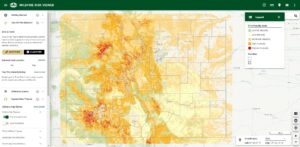
Example of a map generated in the CO-WRAP Public Viewer.

CO-WRAP Features Two Access Levels

  • A professional viewer for community leaders, planning professionals and forestry professionals
  • A public viewer for interested citizens

Professional Viewer

  • This viewer provides access to data and tools for use in creating fire protection or forest stewardship plans, or identifying priority fuels treatment areas.
  • It also allows users to generate detailed risk summary reports for customized land areas – such as neighborhoods, Fire Protection Districts or counties.

Public Viewer

  • This viewer provides a simple-to-use tool that allows users to explore wildfire risk and generate maps for specific locations.

“Whether to increase public awareness about wildfire risk, or to put much-needed information at the fingertips of fire managers, CO-WRAP will be a tremendous asset for Colorado,” said Paul Cooke, director of the Colorado Division of Fire Prevention and Control.

To access the CO-WRAP website, go to www.ColoradoWildfireRisk.com.

If you have questions, please refer to our CO-WRAP Q&As (295 KB PDF)

CO-WRAP Informational Flyer (3 MB PDF)

For more information about protecting homes and communities from wildfire, please check our CSFS website.

The Colorado State Forest Service continues to be the lead state agency for providing forest stewardship and wildfire mitigation education to private landowners, following legislation in 2012 that transferred responsibility for wildfire command and control from the CSFS to the newly formed Division of Fire Prevention and Control.

Late Winter the Best Time to Prune Trees

Late winter, from mid-February until early March, is the best time to prune most urban trees. Trees are still dormant at this time of year and, unlike in early winter, wound closure will be rapid if pruning occurs just prior to the time new growth emerges.

Keith Wood, CSFS community forestry program manager, demonstrates proper pruning techniques at a workshop.

Although some elms, silver maples, birch and walnut trees exude sap if pruned in the late winter or early spring, this should not harm the tree.

“Once a tree has established a strong root system, usually within three years after planting, proper pruning is essential to develop strong structure and desirable form,” said Keith Wood, community forestry program manager for the Colorado State Forest Service. “Appropriately pruning trees while they are young can help you avoid more expensive tree care later.”

The CSFS offers the following pruning tips:

  • Know what you want to accomplish before you get out the saw – don't remove any branches without a reason.
  • Remove any torn, dead or broken branches.
  • Develop or maintain a dominant leader, and don't cut off the tops of trees.
  • Prevent branches below the permanent canopy from growing upright or too large.
  • Space the main branches along a dominant trunk.
  • Keep all branches less than one-half the trunk diameter.
  • Retain branches with wider angles to the main trunk, as compared to those with tighter angles to the main trunk.
  • Limit pruning of newly planted trees to the removal of dead, damaged or crossing limbs, or those interfering with the main leader.
  • Always prune at the branch collar – the point where one branch joins a larger one.
  • Avoid removing more than 25 percent of a tree's branches in any one year.
  • If the job requires running a chainsaw overhead or removing large branches/entire trees, contact an insured, licensed, certified arborist. A list of these professionals for your area can be found at http://www.isa-arbor.com.

For more information, visit the Trees section of our website.

Forest Health Report Released: Bark Beetle Epidemics Only One Concern

On Feb. 20, the Colorado State Forest Service released the 2012 Report on the Health of Colorado's Forests at the annual Joint Agriculture and Natural Resources Committee Hearing at the State Capitol. The report details forest health concerns, including insect and disease activity, that span the state.

2012 Report on the Health of Colorado's Forests: Forest Stewardship through Active Management. Photo: Bill Cotton

“Colorado's forest health concerns are not limited to bark beetles in high-elevation forests. We face a broad spectrum of concerns that impact our mountains, plains and urban forests,” said Joe Duda, interim state forester and director of the Colorado State Forest Service. Duda spoke on Feb. 20 at the Joint Ag Committee hearing.

“Only through sound forest management can we ensure that our future forests provide the resources and benefits that will meet the needs of current and future generations,” he said.

Each year, the Report on the Health of Colorado's Forests provides information to the Colorado General Assembly and citizens of Colorado about the health and condition of forests across the state. The report provides figures and maps detailing major insect and disease concerns in the state, including bark beetles and invasive urban tree pests.

According to the report, for the first time in recent decades, the acreage impacted by spruce beetle surpassed that of the mountain pine beetle, with a total of 311,000 acres of active infestation mapped in 2012. Mountain pine beetle-impacted acreage declined for the fourth consecutive year, but the beetle continued to be active on 264,000 acres of ponderosa, lodgepole and limber pine forests.

This is the 12th consecutive year the CSFS has produced a report on the state of Colorado's forests and actions it is taking to mitigate forest health concerns. The theme of this year's report is "Forest Stewardship through Active Management," with an emphasis on the link between healthy forests and forest management.

The principal source of information for the forest health report is the annual aerial forest health survey, a cooperative project between the CSFS and the Rocky Mountain Region of the USDA Forest Service. Other data sources include field inspections, CSFS contacts with forest landowners and special surveys designed to help ensure early detection of potentially invasive insect species.

Copies of the 2012 forest health report are available at CSFS district offices. The report also can be viewed online in our publications library under Colorado's Forests.

Public Forums: Candidates for CSFS Director/State Forester

The Colorado State Forest Service (CSFS) has selected three final candidates for the position of CSFS Director/State Forester, each of whom will be interviewed later this month.

Colorado State Forest Service logo

Following meetings at the Capitol, the candidates will visit the CSU Denver Center and Colorado State University for a series of open forums. If you are unable to attend, the forums at CSU's Lory Student Center will be webcast; however, you will need to register to participate.

For more information about the search and to view webcasts of the forums at Lory Student Center, visit: https://warnercnr.colostate.edu/csfs-forester.

We invite you to join us for the meetings with the candidates, where you may ask questions and get to know each applicant.

Below are the three candidates, with the dates and times for each of their meetings:

CSFS Director Candidate Open Forums — CSU Denver Center
475 17th Street, Denver, CO, 80202
February 21, 2013
10-11:00 a.m.
Mr. Eric Carlson
President and CEO of the Empire State Forest Products Association
February 25, 2013
10-11:00 a.m.
Mr. Michael Lester
Assistant State Forester, Field Operations, Pennsylvania Bureau of Forestry
February 27, 2013
10-11:00 a.m.
Mr. Nathan McClure
Chief Forester, Forest Utilization and Markets Department, Georgia Forestry Commission

CSFS Director Candidate Open Forums — Lory Student Center
Colorado State University, Fort Collins, CO
Lory Student Center, Room 214-216
February 22, 2013
10-11:30 a.m.
Mr. Eric Carlson
President and CEO of the Empire State Forest Products Association
February 26, 2013
10-11:30 a.m.
Mr. Michael Lester
Assistant State Forester, Field Operations, Pennsylvania Bureau of Forestry
February 28, 2013
10-11:30 a.m.
Mr. Nathan McClure
Chief Forester, Forest Utilization and Markets Department, Georgia Forestry Commission

U.S. Forest Service and CSFS Announce 2012 Aerial Forest Health Survey Results

On Feb. 6, the U.S. Forest Service and Colorado State Forest Service released the results of the annual aerial forest health survey in Colorado.

The spruce beetle outbreak is expanding, with 183,000 new acres detected in 2012. The adult beetle is approximately 1/4-inch. Photo: W.M. Ciesla

The survey indicates that the spread of the mountain pine beetle epidemic has slowed dramatically, while the spruce beetle outbreak is expanding.

Mountain Pine Beetle

The mountain pine beetle epidemic expanded by 31,000 acres, down from last year's reported increase of 140,000 acres. This brings the total infestation to nearly 3.4 million acres in Colorado since the first signs of the outbreak in 1996.

Most mature lodgepole pine trees have now been depleted within the initial mountain pine beetle epidemic area. However, the infestation remains active from Estes Park to Leadville.

Spruce Beetle

In contrast, the spruce beetle outbreak is expanding, with 183,000 new acres detected in 2012, bringing the total acreage affected since 1996 to nearly 1 million acres (924,000).

The areas experiencing the most significant activity are on the San Juan and Rio Grande National Forests in southern Colorado.

Spruce beetles typically attack spruce trees downed by high winds. Once the populations of spruce beetles build up in the fallen trees, the stressed trees surrounding them offer little resistance to attack.

Similar to mountain pine beetle, the increase in spruce beetle activity is due to factors that increase tree stress, including densely stocked stands, ongoing drought conditions and warmer winters.

Read more in the release

Additional information will be available later this month with the release of the 2012 Report on the Health of Colorado's Forests.

Now is the Time to Address Home, Community Wildfire Mitigation

With the ongoing drought, low snowpack, and recent brush fires and Red Flag Warnings in effect along the Front Range in Colorado, the Colorado State Forest Service reminds landowners to prepare their homes now for possible wildfire.

Defensible space around this home was created to reduce wildfire hazard. Photo by: C. Randall

“Although there is no guarantee firefighters will be able to save your home during a wildfire, the odds increase if you follow the best-available mitigation guidelines,” said Lisa Mason, outreach forester for the CSFS and Colorado's "Are You FireWise?" program manager. “It's a good idea to get started now, before wildfire danger increases this spring.”

The CSFS recently updated its two principal guides for protecting property from wildfire. FireWise Construction: Site Design & Building Materials (1.3 MB PDF) and Protecting Your Home from Wildfire: Creating Wildfire-Defensible Zones (738 KB PDF) were developed by experts in the fields of wildfire behavior and FireWise construction practices.

Although much of the information in the guides was unmodified from previous years, several important changes were made based on lessons learned from recent wildfires in the wildland-urban interface. Among these changes is an added emphasis on:

  • the ongoing need for year-round maintenance of surface fuels around the home, such as mowing grass and raking up thick beds of pine needles;
  • the importance of keeping gutters, decks and roofs free of pine needles and other combustibles year-round;
  • understanding how wildfires may start from burning ember showers, and not just direct heat and flame, and;
  • describing fuels mitigation in specific forest types.

Information about developing Community Wildfire Protection Plans also is available on our website.

The Colorado State Forest Service continues to be the lead state agency for providing forest stewardship and wildfire mitigation assistance to private landowners, following legislation in 2012 that transferred responsibility for wildfire command and control from the CSFS to the newly formed Division of Fire Prevention and Control.

Funding Now Available for Forest Restoration Projects

Colorado landowners and communities that want to protect forested areas from severe wildfire and other forest health concerns may be eligible for grant funding from the Colorado State Forest Service.

City of Boulder Open Space and Mountain Parks forest restoration project before treatment (above) and after treatment (below).

The CSFS is now accepting proposals for the Colorado Forest Restoration Grant Program, which helps fund projects that demonstrate a community-based approach to forest restoration. Proposals are due by Feb. 27, and must address protection of water supplies or related infrastructure, as well as the restoration of forested watersheds.

Projects should focus on mitigating threats that affect watershed health, such as the build-up of wildland fuels that increase the risk for severe wildfires, which could negatively impact watersheds. Specific project goals also could include preserving older trees, replanting deforested areas and improving the use of small-diameter trees as forest products.

“We encourage forest restoration proposals to engage the Colorado Youth Corps,” said Naomi Marcus, CSFS assistant staff forester. “The Colorado Youth Corps helps connect Colorado youth to the importance of providing protection to our watersheds and communities.”

Projects must be located in communities with a CSFS-approved Community Wildfire Protection Plan. The state can fund up to 60 percent of each awarded project; grant recipients are required to match at least 40 percent of the total project cost through cash or in-kind contributions, which can include federal funds.

An interdisciplinary technical advisory panel, convened by the CSFS in partnership with the Colorado Department of Natural Resources, will review project applications. The CSFS will notify successful applicants by this summer.

Applications and additional information about the Forest Restoration Grant Program are available at local CSFS District offices or on our Funding Opportunities web page.

Green-up the New Year; Recycle Your Holiday Tree

Trees are a valuable renewable resource, and recycling holiday trees naturally contributes to the process of giving these evergreens a second life.

Chipping the trees for mulch or compost is a common recycling practice. Many community recycling programs use the mulch in flower beds and around trees, and the wood chips also provide natural material for walkways and trails. Some programs allow residents to pick up the free mulch in the spring for personal landscaping purposes.

Many recycling centers and county landfills chip holiday trees for mulch or compost.

Prepare your tree for recycling by removing all ornaments, lights, tinsel, hooks, nails, wire, garland and any wrapping used to transport the tree. Flocked and artificial trees are not accepted at drop-off sites.

To locate a tree recycling program in your county, please visit the Recycle Your Tree website or contact your local recycling center or landfill.

Top of Page | 2012 Features | 2011 Features | 2010 Features