Montrose District

Wildfire Protection and Management

Overview

Colorado law identifies county sheriffs as the fire warden for their county and the individuals ultimately responsible for controlling and extinguishing prairie and forest fires on private and state lands within that county (CRS 30-10-513 14 KB PDF). The role of the Colorado State Forest Service (CSFS) is to aid and assist the sheriff and county fire departments with this responsibility. The CSFS fulfills this role by providing training, equipment, technical assistance and funding and by facilitating interagency mutual aid agreements and annual operating plans.

Click on the map to link to the NIFC Geographic Area Coordination Centers

Wildfire Hazard Evaluation and Mitigation

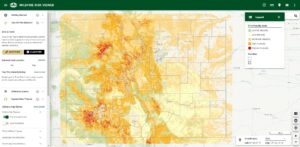
Wildfire Hazard Area Mapping (WHAM)

fire

District personnel can identify and map wildfire hazard areas for county planning departments. ARC/INFO software is used in preparing Geographic Information System (GIS) data. We assist counties at the desired level whether through the complete process of photo typing, ground-truthing and digitizing the data into the GIS, or merely interpreting of the aerial photography and identifying of wildfire hazard areas.

House Bill 1041 Wildfire Hazard Reviews:

CSFS is the designated state agency by H.B. 1041 to review, upon county request (CRS 30-28-136 - 22 KB PDF), the Wildfire Hazard “state area of concern.” (CRS 24-65.1-202- 21 KB PDF)

We adhere to state and national (NFPA 1144) standards for these evaluations. The CSFS also can assist local jurisdictions in the development of appropriate guidelines (CRS 24-65.1-402 - 13 KB PDF) to address wildland fire hazards as a “state area of concern.” To order a current copy of this NFPA 1144, Standard for Protection of Life and Property from Wildfire, contact NFPA or visit their online catalog.

County Fire Planning

The CSFS may assist county commissioners and county sheriffs in their roles of preparing, adopting and implementing county fire management plans (CRS 30-11-124 - 14 KB PDF) that detail individual county policies on fire management for prescribed burns, fuels management or natural ignition burns on lands owned by the state or county.

Prescribed Fire

Fire can be an efficient tool to accomplish many landowner objectives including wildlife habitat, range improvement (33 KB PDF), forest management and wildfire hazard reduction. Landowners often request CSFS assistance in the implementation of an applied prescribed burn (102 KB PDF) that fulfills these land use objectives.

Mitigation

Many rural homeowners ignore or are not aware of common issues related to wildland fires; these hazards often are reduced with carefully planning the location of the building site and use of appropriate construction materials and design, firewise landscaping and maintenance. CSFS assistance includes identifying necessary on-the-ground mitigation, funding mitigation programs through cost-share grants and disseminating educational materials.

Post-fire Rehabilitation

CSFS assists affected landowners with wildfire rehabilitation plans following wildfire events. These plans outline structural erosion control measures and suggest needed re-vegetation to assist the land healing process. Many rehabilitation plans are implemented with cost-share assistance.

Learn more about post-fire rehabilitation

Wildfire Training

Wildland Fire Qualifications - Colorado wildland fire fighters from non-federal agencies are certified through their state district forester. Qualified firefighters are issued a qualifications card commonly referred to as a “red card.” The minimum requirements for a basic firefighter are completions of Basic Wildland Firefighting (S-130) and Fire Behavior (S-190) and completion of the physical fitness test during the current calendar year. The interagency standard physical fitness test is the “Pack Test.” Prior to full qualification, fire fighters are required to complete a task book for each fire position listed on their qualification card.

Colorado West Central Fire Training Association (CWCFTA) - 35 western Colorado fire departments form this membership. This gives them access to training materials which assist in emergency preparedness. CSFS manages the library which contains over 300 titles of films, slides-tapes, and video cassettes.

CSFS District Wildfire Training - Contact us; we can customize wildfire training for county wildfire response personnel to meet your needs.

Colorado Wildland Fire & Incident Management Academy - This CSFS-sponsored academy has become the place for Colorado (and now national and international) wildfire agencies to receive nationally qualifying (NWCG) wildfire training. The Colorado Wildfire Academy is co-sponsored by federal, state, and local agencies; and private vendors. This combination has led to its tremendous success.

National Wildfire Coordinating Group (NWCG) Wildfire Courses:

Agreements and Major Wildfire Assistance

Mutual Aid Agreements & Annual Operating Plans – Each year, federal land fire agencies, state forestry, and counties meet to reach agreement on the sharing of firefighters and equipment if wildfires exceed a particular jurisdiction’s resources. The intent of mutual aid is for all fire suppression agencies to work as a team, avoid duplication, and suppress wildfires efficiently. The Annual Operating Plan defines the limits of interagency cooperation and contains a mobilization plan that identifies the location and availability of firefighters and equipment.

Emergency Fire Fund (EFF) – This fund, established in 1967 by some counties that recognized that some wildfires may exceed the counties’ resources and abilities to manage. Participation in the EFF is voluntary. A ten-person committee comprising county commissioners, sheriffs, fire chiefs, and the state forester oversees the administration of the fund. Currently, 43 Colorado counties and the Denver Water Board contribute to EFF. A county’s annual assessment for EFF is calculated using a formula based on the acreage of private watershed and the annual property tax valuation. Counties with large amounts of private watershed land and a high assessed valuation pay more into the fund than rural counties with large acreage of federal lands and low assessed valuation. Emergency funding requests must originate from the county sheriff and State Forester approval is required. Once accepted, an EFF fire is managed under the direction of CSFS. Map of EFF Counties (259 KB PDF)

Federal and State Funding Assistance – CSFS is authorized by the Governor as the primary point of contact with the Federal Emergency Management Agency (FEMA) when wildfires pose an imminent threat to life and property. CSFS requests, and if awarded, administers FEMA Fire Management Assistance Grants (FMAG). FMAGs provide for up to 75 per cent of eligible costs in the suppression of catastrophic wildfires.

Wildfire Emergency Response Fund (WERF) – This State of Colorado fund was first designated and funded by the state legislature in 2002. (CRS 23-30-310 - 13 KB PDF) The fund reimburses a fire department or county for the first retardant load on state and private land initial attack fires at the request of the county sheriff, municipal fire chief, or fire protection district. In 2006 the legislature expanded authorities in the WERF to include reimbursement of 2 days of hand crew use with preference to state inmate crews. The goal is reduced suppression costs by attacking fires quickly to keep them small.

Interagency Incident Management Teams – Once a wildland fire burns beyond the initial and extended attack capabilities of local forces, the local responsible agency often requests management assistance in the form of a local Incident Management Group or a Type II or Type I Incident Management Team. These teams are available across the nation; the Rocky Mountain Area currently has one Type I team, three Type II teams, and one Fire Use team. Rocky Mountain area teams are interagency, consisting of individuals from the private sector, local fire departments, counties, state and federal agencies.

Learn more about these interagency incident management teams at the Rocky Mountain Coordination Center.

Wildfire Suppression Equipment

Engines – CSFS has placed 140 federal excess property vehicles located throughout the state. Our fire equipment shop in Fort Collins converts these vehicles to wildland fire engines and provides all major maintenance. The all-wheel drive (4x4 and 6x6) engines are equipped with pumps, 200- or 1000-gallon tanks, hose reels, equipment boxes, and are loaned out to fire departments and counties ready to fight wildfires. The cooperator is responsible for minor maintenance and provides small equipment such as hose, nozzles, and hand tools.

These engines are inspected annually and updated as technology advances and budgets allow. Improvements such as low profile tanks, foam injection systems, compressed air foam systems, and multi-fuel engines have made the fleet safer and more effective. State engines, with their fire department crew, are often components of the CSFS-sponsored engine teams used to combat large federal fires throughout the west.

CSFS has also added state-owned commercial chassis wildland engines to the resource pool that protects life and property in Colorado. Currently, 17 engines are located at CSFS district offices or with cooperators. They serve to bolster local resources and are available to respond to wildfires anywhere in the state.

All CSFS wildland engines, both federal excess property and state-owned, meet or exceed National Wildland Coordinating Group (NWCG) standards for wildland engine types.
Our fire equipment shop fabricates a limited number of custom wildfire engines for those departments unable to obtain this service elsewhere.

Single Engine Air Tanker (SEAT) – CSFS contracts and manages Single Engine Air Tankers (SEATs) during most of the summer fire season. The number and location of SEATs varies throughout the year as fire activity changes. The aircraft are pre-positioned around the state in response to high fire danger in coordination with federal and county jurisdictions. Colorado has found that SEAT aircraft complement helicopters and large air tankers in wildfire suppression. They are well suited to Colorado’s high elevations, rugged terrain, and expanding wildland urban interface. Look here for current SEAT activity (163 KB PDF).

Fire Equipment – CSFS is the connection for local and county fire agencies to purchase wildfire equipment through General Services Administration (GSA) contracts. Federal agencies contract with suppliers for fire equipment with the resulting volume providing savings. CSFS provides this service for our local fire agencies, using an electronic mail order system. Fire departments also save on Class A foam which is bulk ordered by CSFS.

Contact your local CSFS district office for more information about this service.