Healthy Forests Vibrant Communities Report – 2024
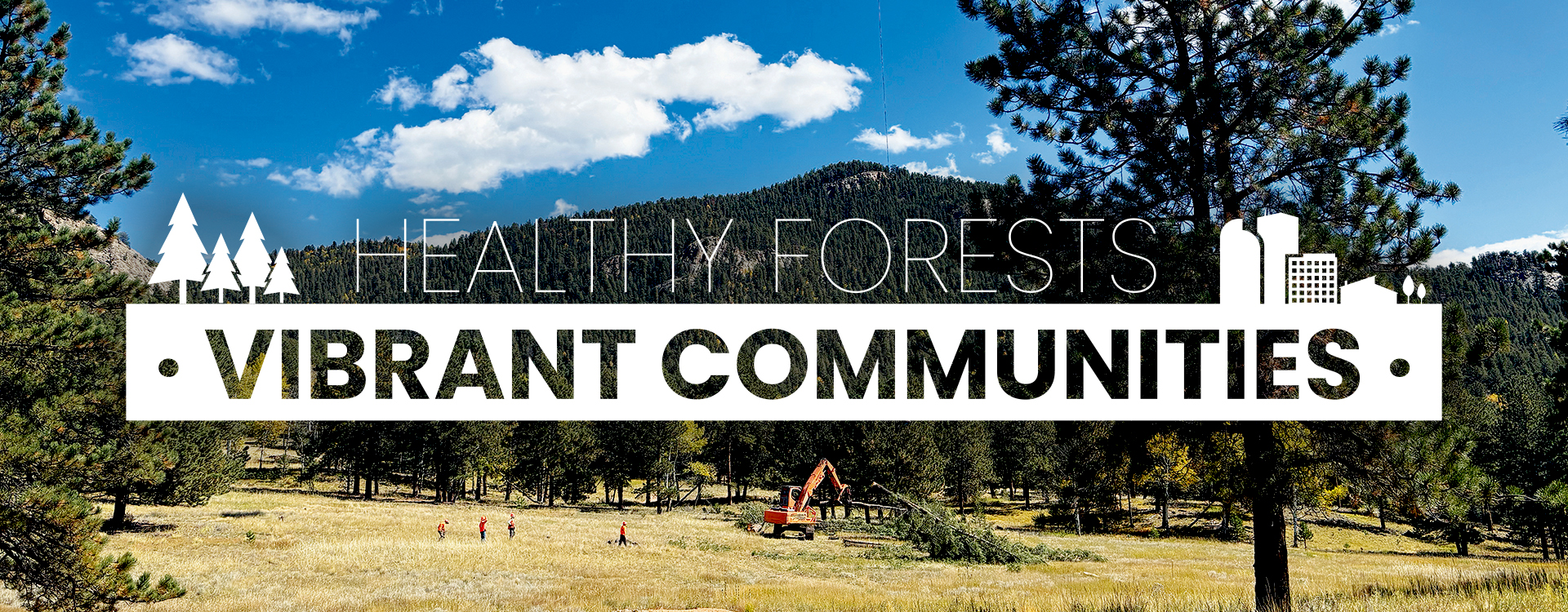
2024 Healthy Forests & Vibrant Communities Report
Since 2009, the Colorado General Assembly has supported proactive efforts to enhance the health of Colorado’s forests with a variety of legislative bills, beginning with House Bill 09-119, in support of the Healthy Forests & Vibrant Communities Act. The purpose of this act is to increase the capacity of the Colorado State Forest Service to ensure the long-term health and vitality of Colorado’s forests. It is the role of the CSFS to provide private landowners, communities and partners with the tools they need to address forest and watershed health and wildfire risk to communities and the forests that surround them.
The Healthy Forests & Vibrant Communities Act advances the ability for the CSFS to engage in the following activities:
- Implement forest management and fuels reduction projects
- Reduce wildfire risk to life, property and watersheds
- Assist communities and others to develop Community Wildfire Protection Plans
- Support utilization and marketing of wood products
- Provide loans to forest products businesses
- Develop and update a public website with geospatial data to assist with assessing wildfire risk and project planning

Message from Director Matt McCombs
Making sure Colorado’s forests are resilient and ready to face the rest of the 21st century is our top priority as an agency. Our forests are crucial for clean drinking water for millions of Colorado residents as well as residents in other states, and they provide clean air, wildlife habitat, breathtaking vistas, and energy and materials. It is true that insects and disease as well as climate change and wildfire continue to threaten our forests, so the Healthy Forests & Vibrant Communities Act provides necessary funding to meet these challenges head on. I’m impressed over and over again with the creative, innovative and scientifically sound ways that CSFS staff use this funding to improve the health of Colorado’s forests for future generations.
2024 Accomplishments
All available HFVC funds for forest restoration and wildfire mitigation projects were awarded in previous years. Of the nine projects recently funded, there are currently eight in-progress and one completed that treated 98.6 acres.

The Fraser Valley Watershed Project
The Fraser Valley Watershed project is a $1 million project occurring across 35 different land ownerships. The project is strategically aligned to treat adjacent lands under the Good Neighbor Authority and Congressionally Directed Spending programs, having a much larger benefit to the community.
The project is expected to have six contracts with one completed, four currently active at the end of 2024, and the final to be awarded and implemented in 2025 through 2026. Once completed, this project will have treated approximately 1,000 acres and linked treatments across the western Fraser Valley to create an approximately 6-mile long fuel break. Strong partnerships with local industry and strategic project design have led to success for this complex project.
Community Wildfire Protection Plans (CWPP)
HFVC funds continue to be used to support CWPP development in select communities that were unsuccessful competing for federal funding meant for the same purpose. Some of these plans are now complete, making the communities eligible for funding intended to support implementation efforts outlined in the CWPPs.
- 12 new CWPPs
- 26 updated CWPPs
- 274 total CWPPs in Colorado
Firewise USA®
Firewise USA is a program developed by the National Fire Protection Association and administered in Colorado by the CSFS. It promotes wildfire risk reduction planning, education, investment and action and is delivered at the local neighborhood level. In 2024, we added 26 sites, and we now have 246 in Colorado in good standing.
Colorado Wildland Fire Conference
The 2024 Colorado Wildland Fire Conference was held in Snowmass Village in October. About 10 CSFS employees participated in the conference, with one supporting conference development as a planning committee member and agency liaison. The CSFS also provided financial support to the conference as a recurring sponsor. State Forester Matt McCombs was a keynote panel presenter on the first day .

Outreach
Assessing Structure Ignition Potential (ASIP) trainings
- 4 sessions: Centennial, Divide, El Jebel, Steamboat Springs
- 137 students trained
Wildfire Mitigation Guides
- Distributed 8,036 Home Ignition Zone guides
- Distributed 1,203 Spanish language Home Ignition Zone guides
- Distributed 2,244 Low-Flammability Landscape Plants
- Completed online version of Fire-Resistant Landscaping
Live Wildfire Ready
In 2024, the CSFS and a steering committee of partners continued the Live Wildfire Ready campaign to raise awareness among Colorado residents to be prepared for wildfire and inform them on what they can do to mitigate wildfire risk to their life, home and property.
For its second year, the Live Wildfire Ready campaign featured a new video that expanded the reach of the campaign to screens across Colorado, from TVs to movie theaters to personal devices.
- The campaign has garnered more than 18 million impressions across a diversity of tools since its inception in May of 2023.
- Nearly all campaign materials directed people to LiveWildfireReady.org, which offers valuable information on wildfire risk, actions to take and resources to explore; the website has earned more than 23,000 pageviews since May of 2023.
The CSFS set up an easy-to-use form for partners across the state to use to request outreach materials to promote Live Wildfire Ready. It was live April 23, 2024, in time for the busy summer outreach season. Between April 23 and Dec. 15, 2024, the CSFS fulfilled 44 orders for 24,753 outreach items (stickers, checklists, koozies, tote bags and tape measures).
Wildfire Mitigation Outreach grant program
The new Wildfire Mitigation Outreach grant program launched in 2024.
- $300,000 to award
- Funded 12 projects in 24 counties
- With the required minimum of 10% match, this puts $594,000 toward wildfire mitigation outreach efforts across Colorado
- Received 28 applications requesting more than $1,330,000 in funds
CSFS.colostate.edu
The CSFS website continues to be a valuable forestry resource for Colorado residents. Throughout 2024, the website hosted 307,000 active users.
In the summer of 2024, the CSFS revised and updated the existing Natural Resources Grant Database to be more user friendly and easier to search.
Woody Biomass Utilization, Consumption and Production in Colorado
The CSFS produced a Woody Biomass Utilization, Consumption and Production in Colorado draft in 2023 and continued to finalize and refine outputs in 2024 with expected completion in 2025. The assessment characterizes and quantifies wood biomass resources across the state using US Forest Service Forest Inventory and Analysis (FIA) data. It also evaluates harvesting, transportation, delivery systems, utilization and markets; energy production technologies; the social, economic and environmental considerations associated with utilization; and provides procurement and policy recommendations.
The CSFS provided nine presentations to 370 partners on the biomass assessment in 2024. County-level estimates were shared with three counties, enabling localized biomass assessments to inform decision-making and project planning. Further, estimates were provided to the Colorado Mass Timber Coalition for strategic planning and to a CSU working group studying biochar feasibility for plugging oil and gas wells under HB23-1069.
Carbon Accounting Framework
The CSFS partnered with the Natural Resource Ecology Laboratory to estimate and monitor changes in forest carbon stocks statewide from 2002-2019. The estimates are disaggregated across several categories including forest cover type, ownership, county, and disturbance. The technical report underwent multiple revisions with input from internal and external partners and is slated for release in January 2025. Results were briefed to the Colorado Wildfire Matters Review Committee in April 2024. A web dashboard with filtering and download capabilities, along with two S&D Bytes have been developed to accompany the report. In 2024, the CSFS provided eight presentations to 350 partners on the Colorado Forest Carbon Inventory and recorded a podcast to share key findings.
Monitoring for Adaptive Management
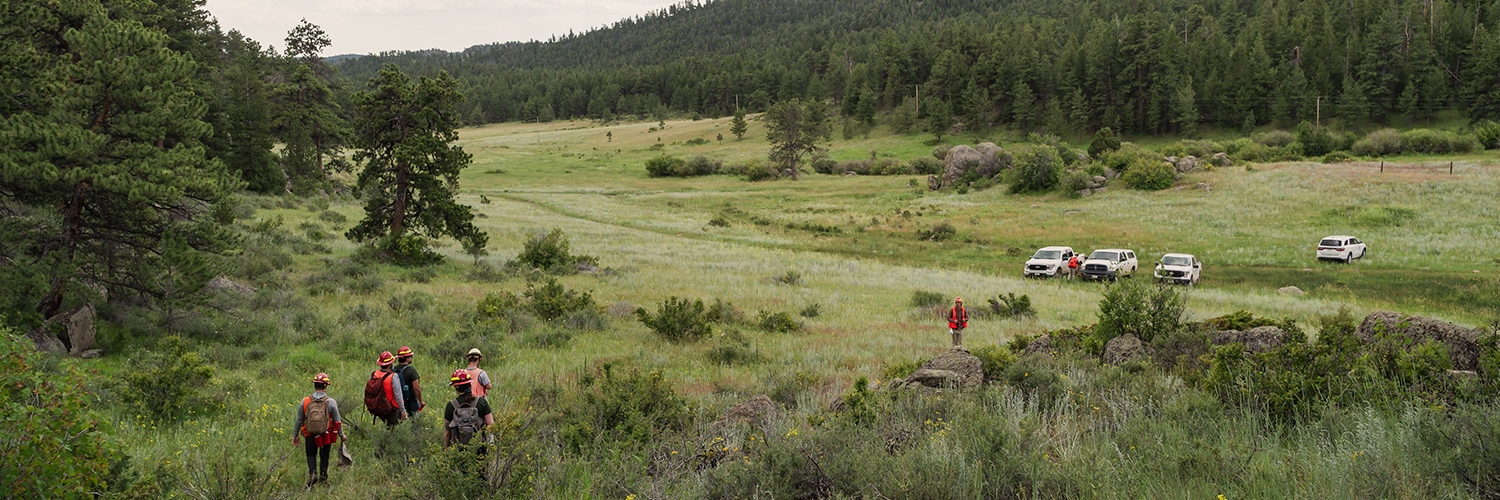
In 2024, the CSFS monitoring crew visited or installed 203 plots across an expected 2500 acres of treatments associated with both Forest Restoration and Wildfire Risk Mitigation (FRWRM) and Healthy Forests and Vibrant Communities (HFVC) funding. Of these acres, 350 are HFVC projects located outside the city of Fraser as well as ongoing treatments at Staunton State Park. The monitoring crew also re-visited several projects from early FRWRM projects completed in 2018 and 2019, expanded monitoring to include snow water equivalent at State Forest State Park, and used newly acquired Lidar Drone purchases to assess how point clouds of forest land can relate to field-collected measurements. The monitoring team conducted field-measurements associated with Rocky Mountain Research Station (RMRS) research projects looking to provide estimates of error associated with drone-derived structure-from-motion point clouds at Manitou Experimental Forest. The monitoring crew will be adding an additional crew for the summer/fall 2025 field season including hiring a new full-time employee to lead a seasonal monitoring crew.
The Colorado Forest Health Council is a volunteer stakeholder body whose role is to provide a collaborative forum to advise the Governor, through the Executive Director of the Department of Natural Resources and the Colorado General Assembly, on issues, opportunities and threats to Colorado’s forests. The Council was reestablished during the Colorado 2021 Legislative Session with 26 members representing all corners of Colorado. The Council’s updated mission includes improving forest health in Colorado through integrated, science-based approaches, with a focus on cross-jurisdictional collaboration among federal, state and local governments, as well as private and nonprofit partners to reduce wildfire risk, restore ecological resilience, safeguard communities and water supplies, mitigate and adapt to climate change, support local economies, and protect recreation areas.
HFVC dollars will go toward the support of the council itself as well as the creation of several projects to be led by the Forest Health Council. With the funding provided by the HVFC, the council will be able to 1) reimburse the cost of attending in-person meetings of the council, including hotel and per diem; 2) continue the work of creating a Forest Resilience Planning Guide; and 3) contribute to the 30-Year Vision as prescribed by statute, by supporting a facilitator.
By supporting these projects and the council, the following goals will be achieved:
- The planning guide provides a starting point on how to access science-based modeling, existing resources and technical capacity, and statewide priorities to improve existing processes in pre-fire planning and forest health efforts.
- The facilitator will provide the necessary tools for the council to develop a 30-Year Vision for forest health in Colorado, including developing goals and both annual and multi-year recommendations for actions to improve forest health and reduce fire risk through increased funding and capacity building.
- Ensure council members can participate without financial barrier.

The CSFS added a new biomass utilization and marketing specialist in 2024 to increase support for our timber harvesting, wood products manufacturing and wildfire mitigation industries. Lending activity from the Wildfire Risk Mitigation Revolving Loan Fund decreased in 2024. Most often, industry expressed concern over declines in demand for their products and uncertainty related to the national election cycle. Inquiries to the loan fund remained active from wildfire mitigation startups.
CSFS staff support to the USDA Wood Innovations Grant and Hazardous Fuels Transportation Assistance Programs resulted in more than $2 million in awards to forest products businesses and organizations. In several cases, CSFS financial support to businesses allowed these USDA grant recipients to meet their federal matching requirements.
The CSFS also submitted an application to the USDA Temporary Bridge program to allow the CSFS to purchase and provide temporary bridge structures to qualified timber harvesting contractors. The CSFS will retain ownership of several bridges and provide them to qualified contractors and partners on a rental fee basis. The bridges will allow the CSFS and its partners to increase areas available under management and to increase the capacity of the CSFS to improve water quality and protect streamside management areas and best management practices (BMP) compliance.
A unique collaboration with the Oregon Department of Forestry resulted in Forest-to-Farm, a video illustrating carbon pathways from wildfire mitigation activities to carbon deficits present in agricultural soils on the eastern slope of Colorado.
The CSFS also provided ongoing technical assistance and guidance to several counties engaging in strategic biomass supply and utilization planning. Larimer, Douglas and Boulder counties are all using guidance provided by CSFS biomass utilization and science and data staff to their biomass and hazardous fuels mitigation efforts. Biomass specialists continued to provide formal guidance on biomass utilization to Forest Restoration and Wildfire Risk Mitigation grant program applicants. The CSFS biomass specialists also worked with several new companies based on a carbon and climate mitigation business and carbon credit model producing bio-oils, biochar and other long-term carbon sequestration products. Specialists continue to sit on committees for collaboratives including the Colorado Mass Timber Coalition and Rocky Mountain Restoration Initiative.
The Workforce Development Grant, established by SB 23-005, was rolled out in May 2024. The program allows for companies to apply for CSFS cost-share for hiring and training new employees in the industries of forest products manufacturing, timber harvesting and trucking, forestry and/or wildfire mitigation services. To date, 11 awards have been made to 10 companies for a total of $64,330 awarded. Most awards have been made to sawyers and equipment operators employed with wildfire mitigation companies.
The CSFS Colorado Woody Biomass Assessment will characterize and quantify wood biomass resources across the state using US Forest Service Forest Inventory and Analysis data. It will also evaluate harvesting, transportation, delivery systems, utilization and markets; energy production technologies; the social, economic, and environmental considerations associated with utilization; and provide procurement and policy recommendations. Two chapters of the Assessment were submitted to the US Forest Service Rocky Mountain Research Station for publication as General Technical Reports. Final content development and technical edits are being completed by a contractor with the plan to release the report to the public in 2025.
Geospatial Data & Technology Enhancements
The CSFS Geospatial Data and Analysis program used HFVC funds to make several large technological enhancements to the CSFS drone, field data collection and data processing fleet. The program made the following purchases, which will help in our work to study forest structure, remote monitoring and prescription scenario planning projects, and to reach our goal to transition these methods to applied settings in the agency:
- DJI Mavic 3 RTK Multispectral – this new drone provides a replacement for our existing aging mapping drone for standard color orthomosaic mapping, but also provides additional near-infrared and red edge spectral bands to test the use of spectral indices in drone remote sensing applications.
- DJI Matrice 350 RTK – this new drone allows us to carry new, and more complex, payloads, including the L2 LiDAR, but also fly longer missions with increased flight times that can be further extended by swapping out batteries while in flight.
- DJI L2 LiDAR Sensor – this sensor allows for 5-return, ~4-5 cm resolution LiDAR point cloud collection and RGB photo capture within a single unit when integrated with the DJI Matrice 350 RTK. This sensor will allow us to explore higher resolution data collection of forest structure and mapping, fuels measurements, and other experimental methods such as snow depth comparisons.
- Trimble R12i Base Station – this extremely capable GPS unit complements the new drone platforms by providing a high-resolution GPS base station with sub-meter accuracy for more precise LiDAR and photo data capture to ensure that data products are spatially correct and useful for real-world planning purposes.
- (2) Trimble DA2s – these handheld GPS receiver units provide high resolution GPS accuracy in a handheld format that can be used for field data collection. These are being tested for wider use across the agency and for integration into our drone mapping workflows to speed ground control point collection and post-processing data correction on drone derived products.
- HP Z2 Tower G9 Workstation Desktop PC – this new workstation allows staff across the CSFS Science and Data division ample processing power to run new analysis, test cutting-edge processing software, and develop new data products efficiently as we test and implement new remote sensing methods.
The CSFS GIS team also developed and launched the CSFS Open Data Portal that provides a platform to serve streaming data layers and web maps from the Colorado Wildfire Risk Assessment, Colorado Forest Action Plan and Forest Health Program to the public. This allows our federal, state and local partners, as well as students and researchers to access CSFS authoritative data and visualize it in their own projects and web maps and applications. This reduces duplication of CSFS data across the web, ensures the authoritative versions are highlighted and properly attributed, and minimizes the amount of staff time spent sharing data with users.
Colorado Wildfire Risk Assessment & Colorado Forest Atlas
In 2024, the 2022 Colorado Wildfire Risk Assessment (CO-WRA) produced the following metrics:
- 724 Wildfire Risk Reduction Planner unique user logins (1/1/2024-10/10/2024)
- 3,439 Total professional user accounts in the Colorado Forest Atlas (as of 10/10/2024)
- 293 CO-WRA risk reports generated (as of 10/10/2024)
- 776 Forest Atlas support contacts, including user requests, data support and application support questions (as of 10/9/2024)
CSFS GIS Capacity Building and Support
The CSFS GIS team lead 2 internal webinars/training events:
- ESRI Field Maps and Data Collection
- CSFS GIS Data Management Refresh
The CSFS GIS team
- Responded to 294 internal staff GIS support tickets.
- Conducted 27 new employee GIS onboardings.
- Participated in, or presented at 3 conferences:
-
- 2 staff attended the Colorado Forest Collaboratives Summit in Durango, CO to interact with watershed and fireshed collaborative partners, especially those who we work with on interactive web mapping applications and work tracking projects.
- 1 2024 SAF Presentation in Loveland, CO – “Navigating Challenges, Exploring Possibilities: Building a Drone Program at the Colorado State Forest Service.”
- 5 attended, and 2 posters presented at 2024 GIS in the Rockies Conference in Denver, CO – “Colorado Forest Tracker” & “Colorado Wildfire Risk Assessment.”
The CSFS has increased capacity throughout the agency to provide project and program administration for the activities supported by the Healthy Forests and Vibrant Communities Act.
Looking Ahead
Other efforts planned for 2025 and beyond include creation of an online grant portal on the Colorado Forest Atlas for state-funded grant programs such as the Forest Restoration and Wildfire Risk Mitigation grant program and hiring additional capacity for cross-boundary project planning and implementation. Also, HFVC is funding CSFS staff support to provide leadership, expertise and mapping resources to the efforts of the Wildfire Resiliency Code Board (WRCB). This board is working through the process of adopting a statewide WUI code that will go into effect in July 2025.
The additional one-time $7.5 million in funding the CSFS received in 2021 via Senate Bill 21-258 will be fully spent by its expiration on June 30, 2025. The CSFS will continue to support the efforts described in this report at a reduced and sustainable level.